G4 Filter Explained: What It Captures and When It Is Enough
What does a G4 filter do, and when is it enough? A practical guide to supply air, extract air, pre-filters, ISO Coarse and choosing between G4, M5 and F7.
G4 filter explained without the filter-class jargon
A G4 filter catches larger dust, lint and other debris before it builds up inside your ventilation unit. It is a common choice for extract air, pre-filtration and, in some systems, incoming outdoor air too.
Is G4 enough for your home, or should you choose M5 or F7? Start with where the filter goes and what you want it to capture.
✓
The short practical answer
Choose G4 where coarse filtration is enough for the job. For finer filtration of incoming air, consider a compatible M5 or F7 option. Check your unit model before changing filter class.
What does a G4 filter actually capture?
Think about what travels through a ventilation unit. Outdoor air can carry dust, sand particles, fluff and insect fragments. Air extracted from your rooms carries household dust, hair and lint. G4 is there to catch the larger debris before it reaches the heat exchanger and other internal components.
●
Larger dustCoarse airborne dust and debris
≈
Lint and fibresFluff, hair and household lint
◆
Sand particlesLarger particles carried with outdoor air
✦
Insect debrisInsects and larger fragments
That is useful work. A G4 filter is not simply a “worse F7”: it serves a different filtration need. It may also capture some larger pollen particles, but the G4 label alone is not a reliable basis for choosing a pollen filter. If pollen or fine particles from traffic and wood burning are your main concern, look at finer filtration and the actual filter data.
Why not always fit a finer filter?
Every filter adds resistance to airflow. G4 is often used where coarse filtration is sufficient and there is no reason to add more resistance. What matters is that your ventilation unit can still deliver the airflow your home needs.
The filter class alone cannot promise lower noise, lower electricity use or a longer service life. Those depend on the unit, the filter design, the airflow and how dirty the filter becomes.
The three jobs a G4 filter can do
The same filter class can appear in different places. These simplified diagrams show the filtering sequence, not the internal layout of every ventilation unit. Follow your model’s instructions for the actual installation position.
1. Filtering incoming outdoor air
Some MVHR units use G4 on the supply-air side. This can be suitable when coarse filtration meets your needs. But a G4 filter supplied with a new unit is not automatically the best choice for every home. A busy road, seasonal pollen or winter heating pollution may give you a reason to consider a compatible finer filter.
Outdoor airLarger dust and debris
→
G4 / ISO CoarseWhere coarse supply filtration is permitted
→
RoomsAir travels through the ventilation unit
Use where the manufacturer permits it and coarse filtration is sufficient.
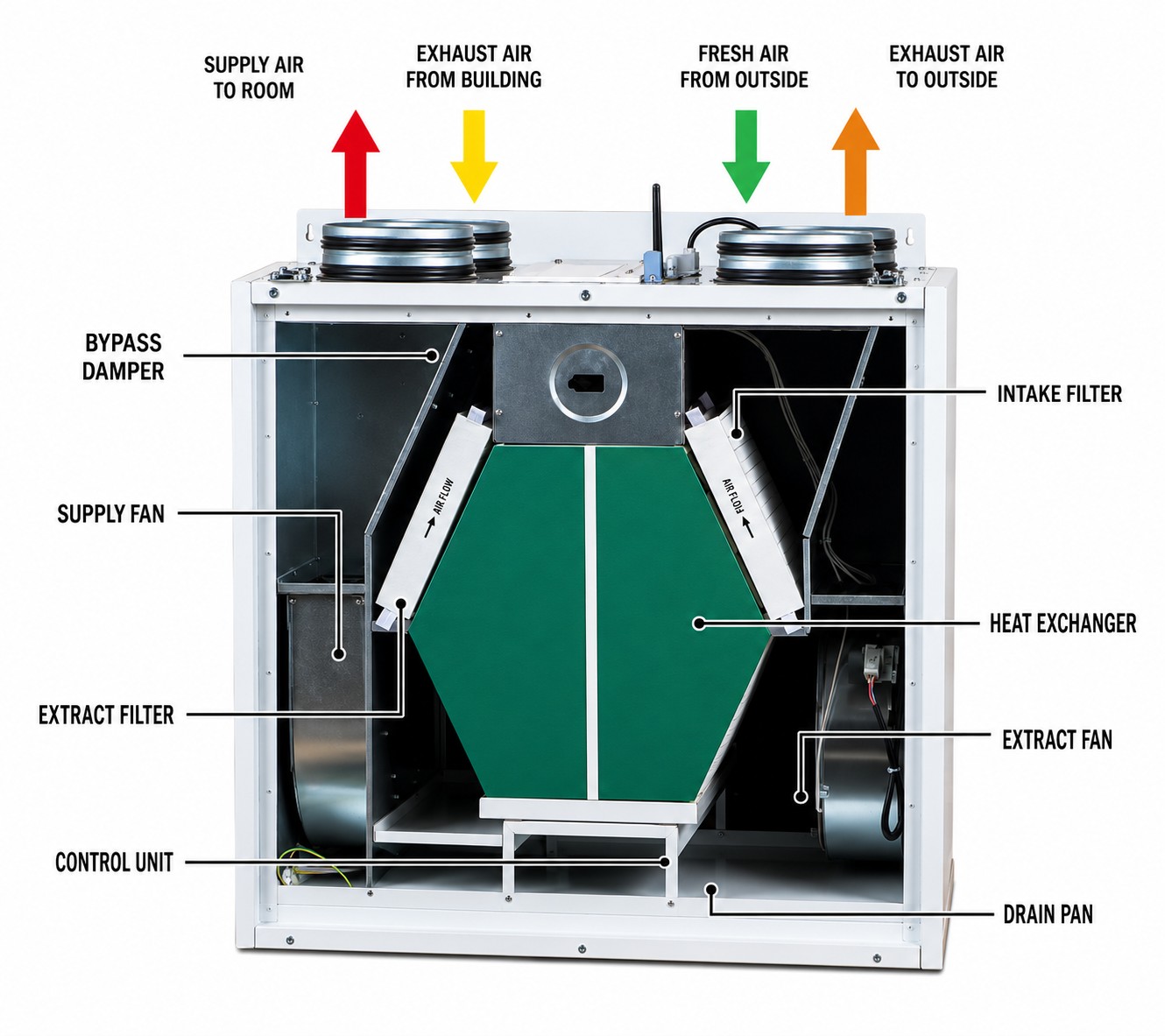
The same typical MVHR arrangement: F7 filters incoming outdoor air, while G4 protects the extract-air side. G4 can also serve other positions when the unit is designed for them. Follow the labels and manual for your model.
Extract air travels from your rooms through the unit and then outdoors. The filter catches household dust and lint before they can build up inside the unit. G4 is often enough for this job.
This is why a set can contain F7 for incoming air and G4 for extract air. The two filters have different jobs; they do not need to have the same class.
Indoor extract airDust and lint from your rooms
→
G4 / ISO CoarseProtects the unit and heat exchanger
→
Exhaust airAir leaves the building
Here the filter’s main job is to protect the unit from indoor dust and lint.
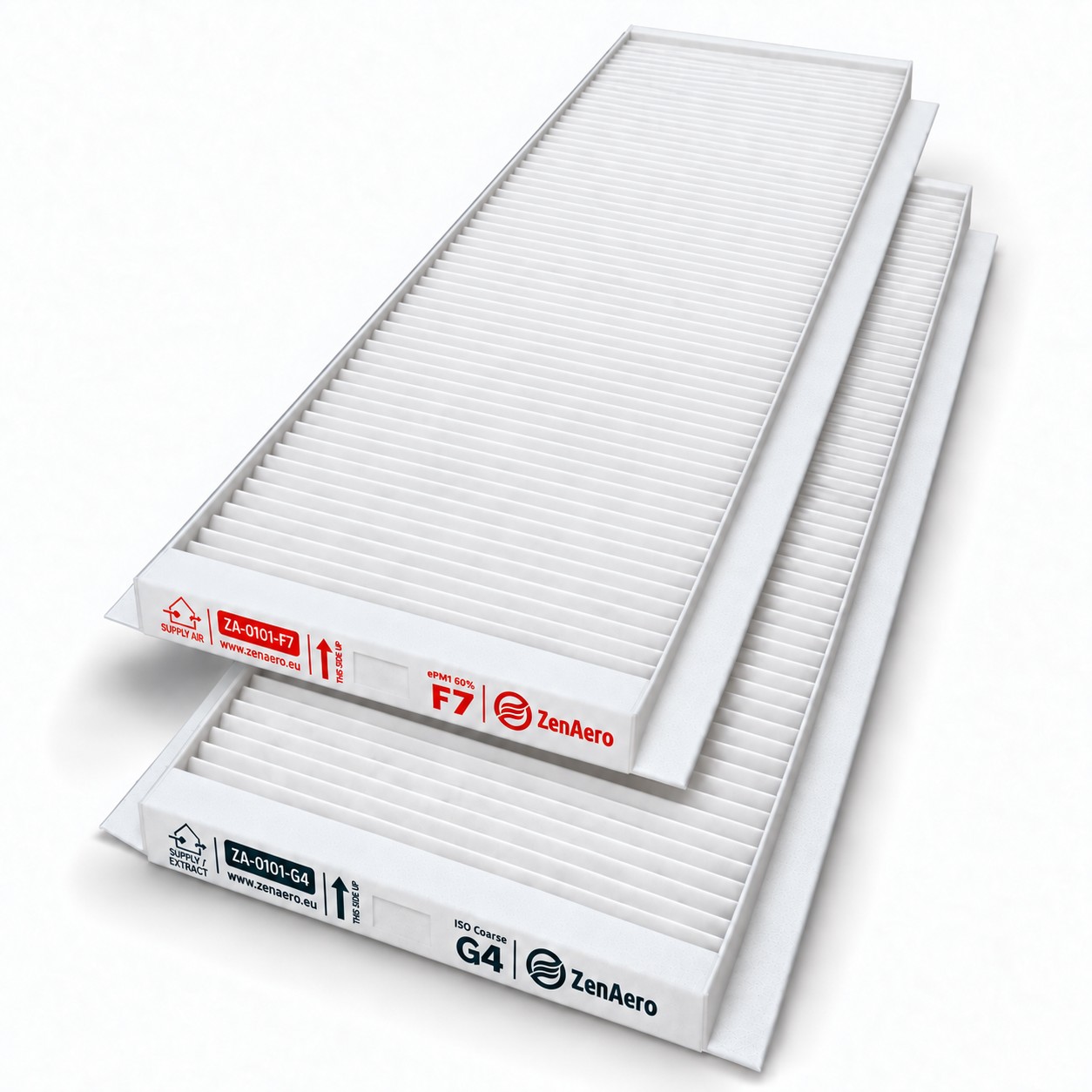
ZenAero compatible Zehnder ComfoAir Q 350 F7 and G4 filter set
F7 + G4 example: Zehnder ComfoAir Q 350
This ZenAero compatible set pairs an F7 supply-air filter with a G4 / ISO Coarse extract-air filter for Zehnder ComfoAir Q 350, Q 450 and Q 600. Each filter measures 499 × 158 × 22 mm. It is a practical example of using finer filtration for incoming air while G4 protects the unit on the extract side.
In systems designed for two-stage supply-air filtration, G4 catches larger debris first. F7 then handles finer filtration. This can reduce the amount of coarse dirt reaching F7 and may help it last longer before it clogs.
G4 pre-filterCatches larger debris first
→
F7 fine filterHandles finer particle filtration
→
Supply airTwo-stage filtration where supported
Do not add an extra stage unless your unit is designed for it.
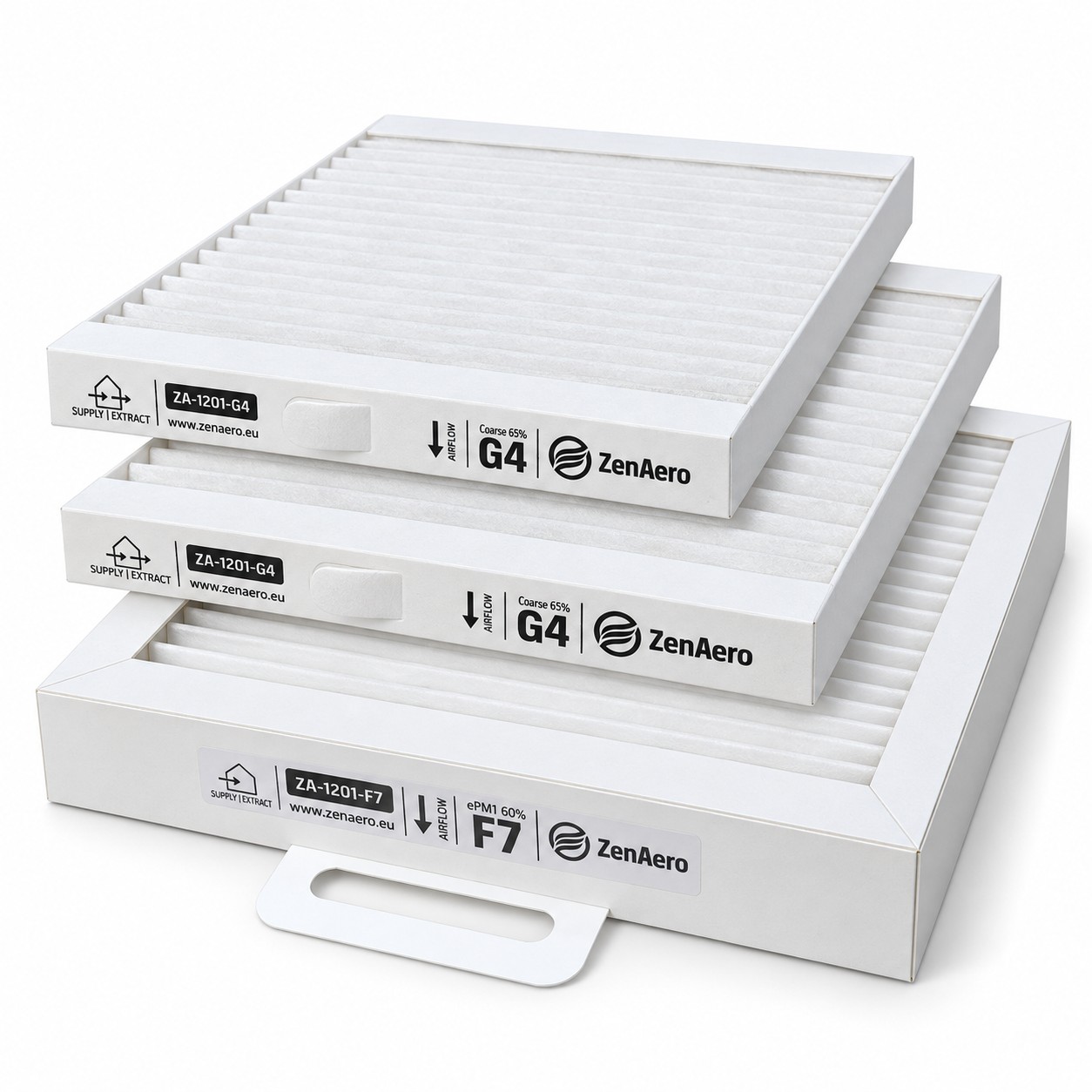
ZenAero compatible Brofer filter set containing one F7 and two G4 filters
This ZenAero set contains one F7 filter and two G4 filters. It is compatible with the listed RDCD25SK / RDCD25SH series variants, not the plain RDCD25 or RDCD25e. Check your unit’s filter arrangement and full model code before ordering.
When is G4 enough, and when should you consider M5 or F7?
Start with the problem you are trying to solve. For an extract-air filter or pre-filter, the specified G4 may be exactly what you need. On the supply side, think about the particles you want to keep out of your rooms.
G4 / ISO Coarse setTwo coarse filters for applications where the unit permits this arrangement.Zehnder ComfoAir Q F7 + G4 setF7 for finer supply-air filtration and G4 / ISO Coarse for extract-air protection.
G4, M5 and F7: a practical comparison of legacy filter classes
Class
Main role
When to consider it
G4
Coarse filtration of larger debris
Unit protection, extract air, pre-filtration or permitted coarse supply-air filtration
M5
Medium filtration, generally finer than G4
When you want improved capture of pollen and other larger airborne particles; compare product data
F7
Finer particle filtration
Incoming air where pollen and finer traffic or combustion particles are a concern
These are general roles, not fixed efficiency percentages or automatic ISO 16890 equivalents. Actual performance and airflow resistance depend on the filter.
M5: an intermediate option
M5 belongs to the medium-filtration group in the older classification. It can be worth considering when G4 does not provide the filtration you want. Compare the specific filter’s ISO 16890 rating and pressure drop rather than assuming that every M5 filter performs identically.
F7: finer filtration of incoming air
F7 is worth considering when pollen and smaller outdoor particles matter to you. But matching the dimensions is only the first check. Your unit must also be able to maintain the required airflow with that filter fitted.
In my own setup, I use F7 during the pollen season, when I notice hay fever symptoms. During the rest of the warmer period, I use G4 because dust from the nearby road clogs my F7 filter fairly quickly. In winter, when heating pollution becomes a concern, I switch back to F7.
This is a practical example of my own choices, not a recommendation to select a filter by the calendar alone. Choosing G4 also means accepting coarser filtration. Your local conditions, needs and permitted filter options may be different.
G4 and ISO Coarse: why do you see both labels?
G4 comes from the older EN 779 classification. ISO Coarse belongs to ISO 16890, which also includes ePM10, ePM2.5 and ePM1 groups. G4 remains familiar because it still appears in unit instructions and replacement-filter descriptions.
The useful point for a buyer is this: there is no single “G4 equals ISO Coarse X%” conversion that applies to every filter. The test methods differ, so check the result given for the actual product. A percentage attached to ISO Coarse is not a promise to remove that same percentage of every pollutant in your home.
You do not need to memorise the standards to buy a replacement. Match the unit model, check the specified filter class and read the current product rating. Our guide to filter markings and airflow direction explains the labels you will encounter.
How to choose the right replacement G4 filter
The easiest starting point is your ventilation unit’s exact model, including any version or suffix. Then work through these checks:
Confirm the model. Similar names do not always use the same filters.
Check the dimensions and construction. The frame, seal and fitting must match as well as the size.
Check the set. Do you need G4 + G4, F7 + G4 or a three-filter combination?
Check each position. Supply and extract filters can differ in both class and size.
A fixed number of months would be convenient, but it would not suit every home. The same filter can clog faster beside a dusty road or building work than in a cleaner setting. How much you run the unit matters too.
Follow the manufacturer’s maintenance guidance and check the filter’s condition. Reduced airflow, more noise or a maintenance alert are reasons to inspect it. They do not prove that the filter is the only cause, but it is a sensible place to start.
Can you just vacuum it? Only if the manufacturer permits that for the particular filter or media. G4 describes a filtration class, not whether a filter is reusable. Vacuuming a disposable filter does not make it new again.
G4 makes sense where you need to catch larger debris and protect the unit. If you want finer filtration of incoming air, consider a compatible M5 or F7 option. Start with your unit model, then choose the filtration level that fits your home and the equipment.
G4 filter sets for your ventilation unit
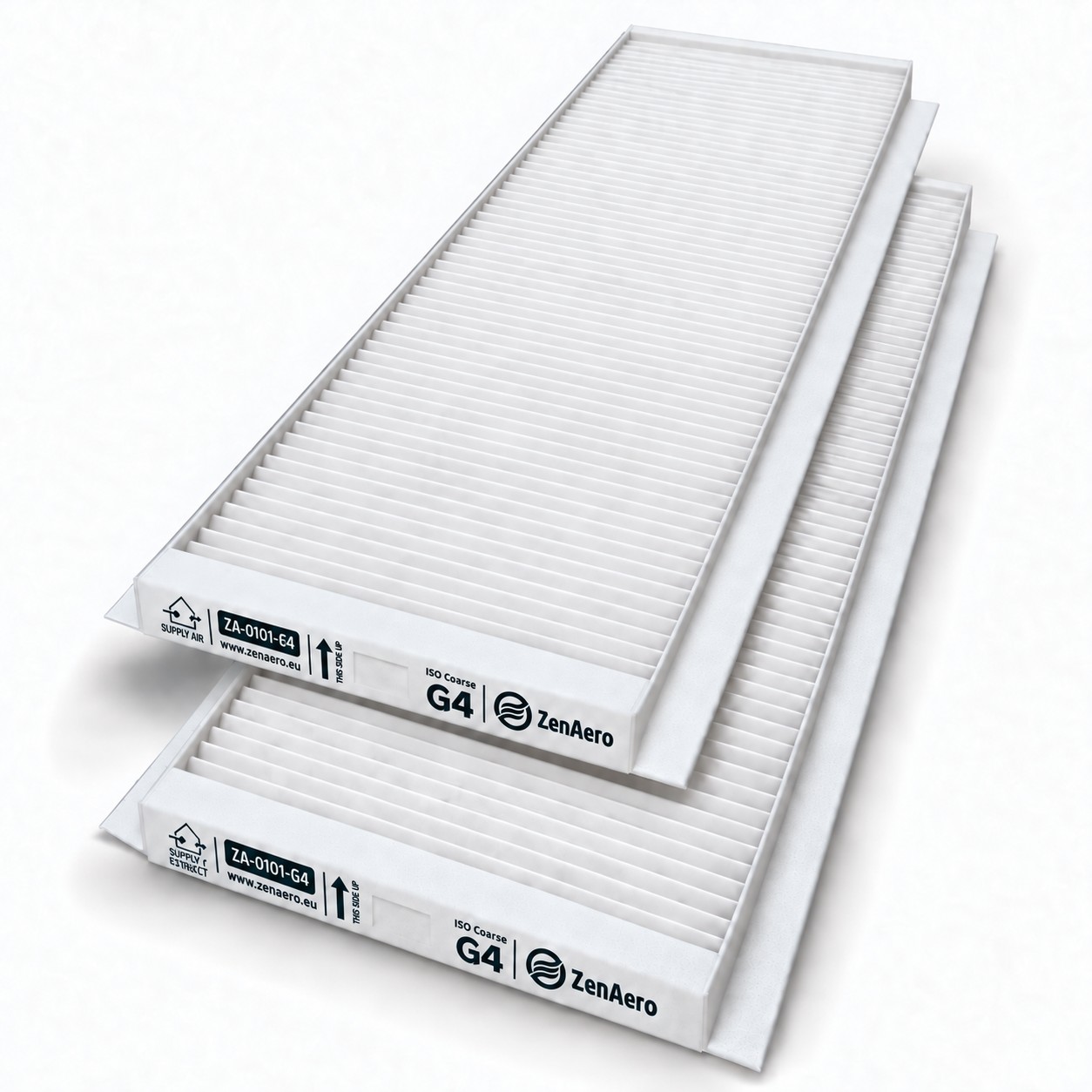
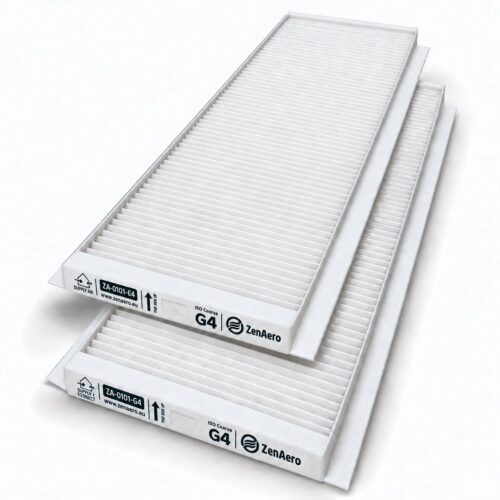
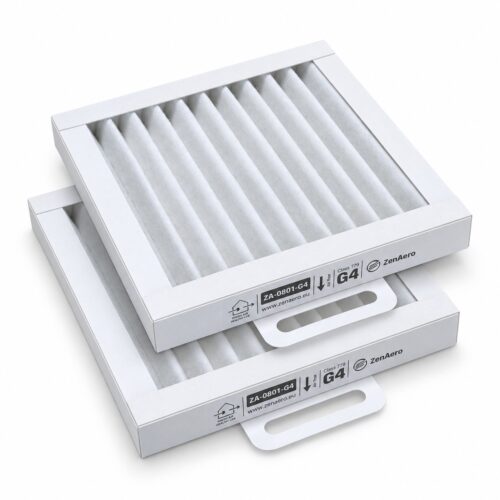
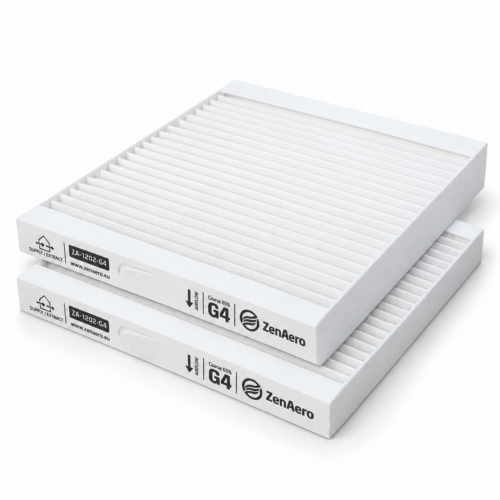
These ZenAero compatible sets contain two G4 / ISO Coarse filters. Choose by the exact unit model and dimensions, not by filter class alone.
It is a coarse-filtration class from the older EN 779 system. In practical terms, it describes a filter intended mainly for larger dust, lint and similar debris.
Is G4 enough for supply air?⌄
It can be, if your unit permits it and coarse filtration meets your needs. If pollen or finer outdoor particles are your main concern, compare compatible finer-filter options.
Does extract air need an F7 filter?⌄
Not necessarily. The extract filter mainly protects the unit from household dust and lint, so G4 is often used there. Follow your unit’s specified arrangement.
Can I replace G4 with M5 or F7?⌄
Yes, where the manufacturer permits the alternative. Matching dimensions alone is not enough: the construction must fit and the unit must maintain the required airflow.
Are G4 and ISO Coarse the same?⌄
They are labels from different classification systems. Filters sold as G4 often also carry an ISO Coarse rating, but the precise result must come from the specific product’s data.
Can G4 work as a pre-filter?⌄
Yes, in a system designed for that arrangement. A G4 stage before F7 catches larger debris and can reduce the dirt load on the finer filter.
How often should a G4 filter be changed?⌄
Follow the manufacturer’s guidance and the filter’s actual condition. Dust levels and operating hours vary, so there is no single replacement interval for every system.
Can I vacuum a G4 filter?⌄
Only if the manufacturer allows it for that filter. The G4 class does not tell you whether it is reusable; disposable filters should be replaced.
To provide the best experiences, we use technologies like cookies to store and/or access device information. Consenting to these technologies will allow us to process data such as browsing behavior or unique IDs on this site. Not consenting or withdrawing consent, may adversely affect certain features and functions.
Functional
Always active
The technical storage or access is strictly necessary for the legitimate purpose of enabling the use of a specific service explicitly requested by the subscriber or user, or for the sole purpose of carrying out the transmission of a communication over an electronic communications network.
Preferences
The technical storage or access is necessary for the legitimate purpose of storing preferences that are not requested by the subscriber or user.
Statistics
The technical storage or access that is used exclusively for statistical purposes.The technical storage or access that is used exclusively for anonymous statistical purposes. Without a subpoena, voluntary compliance on the part of your Internet Service Provider, or additional records from a third party, information stored or retrieved for this purpose alone cannot usually be used to identify you.
Marketing
The technical storage or access is required to create user profiles to send advertising, or to track the user on a website or across several websites for similar marketing purposes.