F7 vs G4 Ventilation Filters: Which One Should You Choose?
F7 and G4 filters do different jobs in an MVHR system. This practical guide explains what each filter catches, where it is normally used, how it affects airflow, and when an F7 upgrade is worth considering.
One of the first questions when replacing ventilation filters is simple: what is the difference between F7 and G4, and which one is better?
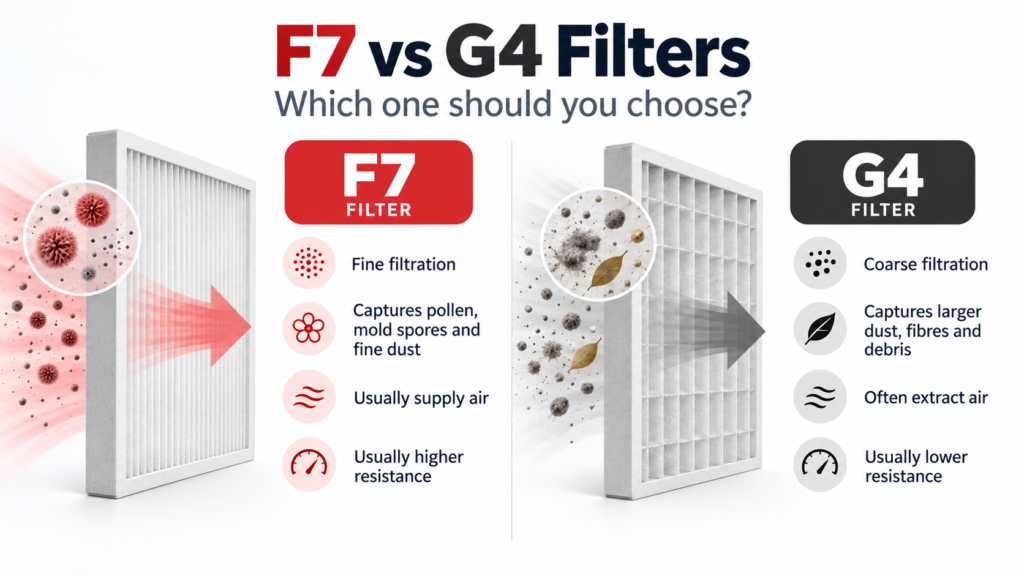
The honest answer is that both can be the right filter. They just do different work. G4 gives basic coarse filtration with lower resistance. F7-type media filters incoming air more closely, including pollen and a larger part of fine dust. Your ventilation unit, outdoor air and comfort expectations decide the rest.
✓
The short practical answer
Choose G4 / ISO Coarse for basic unit protection and easier airflow. Choose a compatible F7-type filter when you want better filtration of pollen and fine particles in the incoming outdoor air. In many two-filter MVHR units the normal set is F7 on supply air and G4 on extract air, but it is not a universal rule. Check the unit manual and the filter position first.
F7 vs G4 filter: which one fits your situation?
Choose G4
Your outside air is acceptable, the unit is designed for G4, and you mainly want low-resistance protection from dust, fluff and insects.
Choose F7-type
You want better filtration of pollen, fine dust and city-air particles, and the ventilation unit allows the finer filter.
Choose F7 + G4
The unit is made for a mixed set: finer filtration on incoming supply air and coarse protection on the extract side.
Question
G4 / ISO Coarse
F7-type / commonly ePM1
Main purpose
Basic protection of the unit
Better filtration of incoming outdoor air
Typical particles
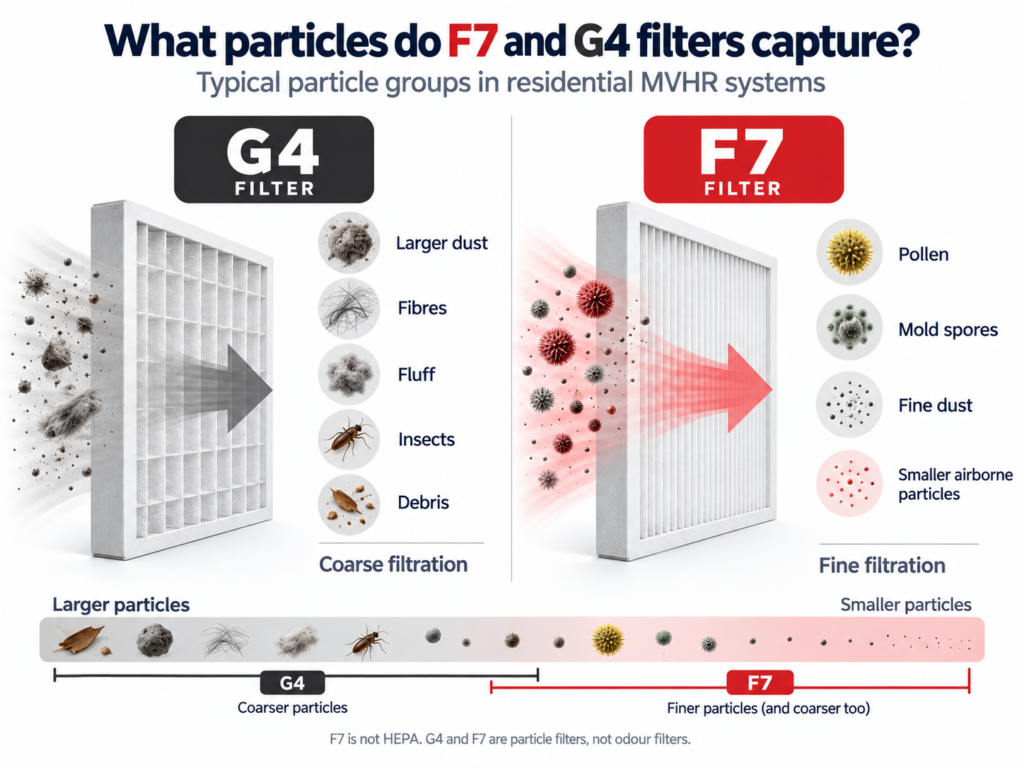
Insects, fibres, fluff and larger dust
All coarse particles, plus more pollen and fine dust
Air resistance
Usually lower
Usually higher, depending on media and filter area
Typical position
Extract air, or both sides when specified
Supply / incoming outdoor air
Good choice when
Simple protection and easier airflow matter most
Outdoor air needs more filtration
Before buying
Check model, dimensions, filter position and allowed class. A filter that fits physically is not always the correct one.
What do G4 and F7 actually mean?
G4 and F7 are old EN 779 filter class names. They are still everywhere: in older manuals, product names and normal conversation. G means coarse filtration and F means fine filtration. The old order was G1 to G4, then M5 and M6, then F7 to F9.
Newer filter labels use ISO 16890. Instead of only giving one letter and number, the newer system groups filters by particulate matter efficiency: ISO Coarse, ePM10, ePM2.5 and ePM1.
G1–G4Legacy coarse filtration
M5–M6Legacy medium filtration
F7–F9Legacy fine filtration
ISO 16890ISO Coarse, ePM10, ePM2.5, ePM1
Do not convert the old class too literally. G4 is commonly associated with ISO Coarse, but the actual percentage still matters. F7 also does not automatically mean ePM1 60%. Different old F7 filters can have different ISO 16890 results. On ZenAero products, read the full declaration shown on that product, for example ePM1 60% or ISO Coarse.
What changes in real use?
G4: the unit-protection filter
Think of it as a practical first barrier. It catches the obvious dirt before it reaches fans, the heat exchanger and internal surfaces.
insectsflufffibreslarger dustplant debris
F7-type: closer filtration of supply air
It also deals with larger dirt, but the reason to use it is finer incoming-air filtration. This matters more during pollen season, near traffic, construction or other outdoor particle sources.
Will you notice the difference immediately? Sometimes yes, sometimes almost not. If the outdoor air is clean and you do not have a pollen problem, G4 may feel perfectly fine. If the air intake is close to a road, a dusty yard or seasonal pollen, the difference can be more obvious. What you should not expect is a miracle: an F7-type filter is not HEPA and it does not remove every particle.
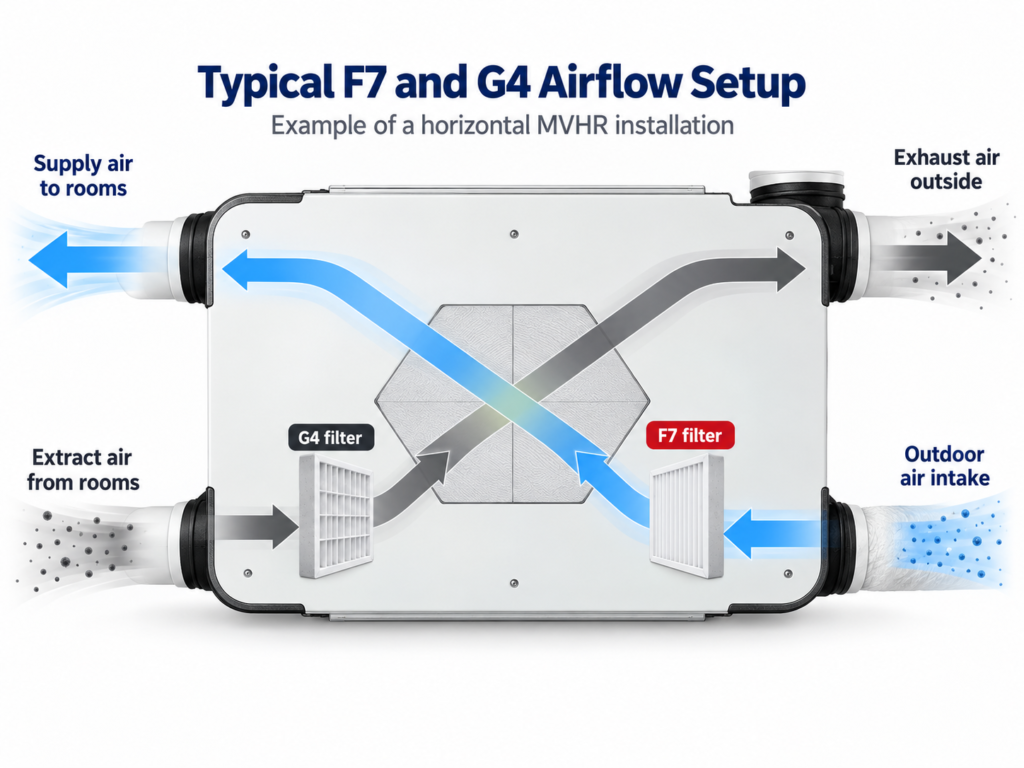
Supply air and extract air, in one picture
Outdoor airPollen, dust, traffic particles
→
F7-type filterUsually the supply-air filter
→
RoomsFiltered supply air enters the home
Indoor extract airAir from kitchen, bathroom and rooms
→
G4 filterProtects the extract side and heat exchanger
→
Exhaust airAir leaves the building
This is a common arrangement, not a rule for every unit. Some systems use G4 + G4, some F7 + G4, some F7 + F7, and a few have a separate optional fine-filter slot.
Which filter should you choose for your home?
My home is in a clean area and G4 already works well⌄
Keep the G4 setup if the manufacturer allows it and you are happy with the air. There is no prize for fitting the densest possible filter. Lower resistance can mean easier airflow, less fan effort and often less noise.
I have seasonal pollen or the intake is near a busy road⌄
A compatible F7-type supply-air filter makes more sense here. It can reduce the amount of pollen and fine particulate carried indoors. Check that the unit is designed for it and do not forget that the filter may need checking more often.
My unit manual shows F7 + G4⌄
Use F7 on the supply / outdoor-air side and G4 on the extract side, unless the manual or unit markings say otherwise. Do not decide by colour. Read the label, airflow arrow and position marking.
My ventilation unit is already noisy or airflow is weak⌄
Do not start by adding a denser filter. First check dirty filters, blocked grilles, closed valves and whether the unit is working close to its limit. An F7 upgrade can make a marginal installation worse.
Can you replace a G4 filter with an F7 filter?
Not automatically. The fact that an F7 filter fits into the same opening does not prove the ventilation unit can use it properly. Fine media usually creates more pressure drop, so the fan must still deliver the required airflow.
Read the unit manual. Look for an allowed F7, ePM1 or fine-filter option.
Check the full dimensions. Length, width and thickness all matter. The frame must seal, otherwise air simply goes around the media.
Identify supply and extract. A fine filter normally belongs on incoming outdoor air, but follow the unit markings.
Watch the unit after the change. Check airflow, noise, fan speed and any filter alarm. If comfort drops clearly, the setup needs attention.
Important: if the unit was selected too small, works near maximum fan speed, or is installed close to a bedroom, even a moderate extra pressure drop can become annoying.
Will an F7 filter reduce airflow or use more energy?
Usually it creates more resistance than G4, but filter class is not the whole story. Media type, pleat area, filter depth, frame design and how dirty the filter is can make a big difference. A well-designed F7 filter may work better than a poor filter with the same class written on it.
More filter resistance
Air and pressure are directly connected. When resistance goes up, the ventilation unit has to react somehow.
WHAT HAPPENS? →
Variable airflow unitAirflow can fall, so less fresh air reaches the rooms.
Constant airflow unitAirflow stays closer to target, but fans work harder and may use more power or make more noise.
In a correctly selected unit the change is often manageable. The problem starts when the extra resistance pushes the fan outside a comfortable working range. That is why I would never judge an upgrade only by the word “F7”. The unit and the actual filter design both matter.
How ZenAero approaches resistance
For our fine-filter products we select synthetic media and a pleat layout intended to keep resistance as low as practical for the stated filtration level. It does not mean F7 has the same resistance as G4, and exact performance still depends on the filter size, airflow and ventilation unit. Lower resistance within the same filtration class can help the unit work with less fan effort.
What about pollen, smoke and odours?
Pollen
A compatible F7-type supply filter is normally the better choice. It catches a much larger share of pollen than a basic coarse filter.
Smoke particles
Fine media can reduce part of the particulate in smoke. It does not make smoky outdoor air harmless and does not remove every fine particle.
Odours and gases
F7 and G4 are particle filters. Smells and gases usually need activated carbon or another suitable adsorption medium.
How often should G4 and F7 filters be replaced?
There is no honest single answer. Replacement time depends on filter surface, outdoor pollution, airflow, pollen season, construction work and how many hours the unit runs. A small F7 filter beside a busy road can load very fast. A larger G4 filter in a clean area can last much longer.
A practical starting point
In normal conditions, people often work around 6–8 months for G4 and 4–6 months for F7. Treat this as a rough check interval, not a promised lifetime.
Inspect earlier when
The intake faces traffic, there is construction nearby, wildfire smoke, heavy pollen, farming dust or the filter is small.
Change it when
Airflow feels lower, the unit becomes noisier, the filter alarm appears, the media is heavily loaded or the manual says it is due.
During the first year, check the filter after two or three months. That gives a much better replacement schedule than blindly trusting a timer. The timer does not see how dirty the outdoor air was.
Common mistakes to avoid
Wrong: choosing by colour or by how “dense” the media looks.
Wrong: assuming every old F7 equals ePM1 60%.
Wrong: putting F7 on extract air just because it fits there.
Wrong: ignoring frame thickness, seals and airflow arrows.
Wrong: washing a disposable filter and damaging the media.
Wrong: expecting F7 to remove odours like activated carbon.
Real F7 filter examples for common ventilation units
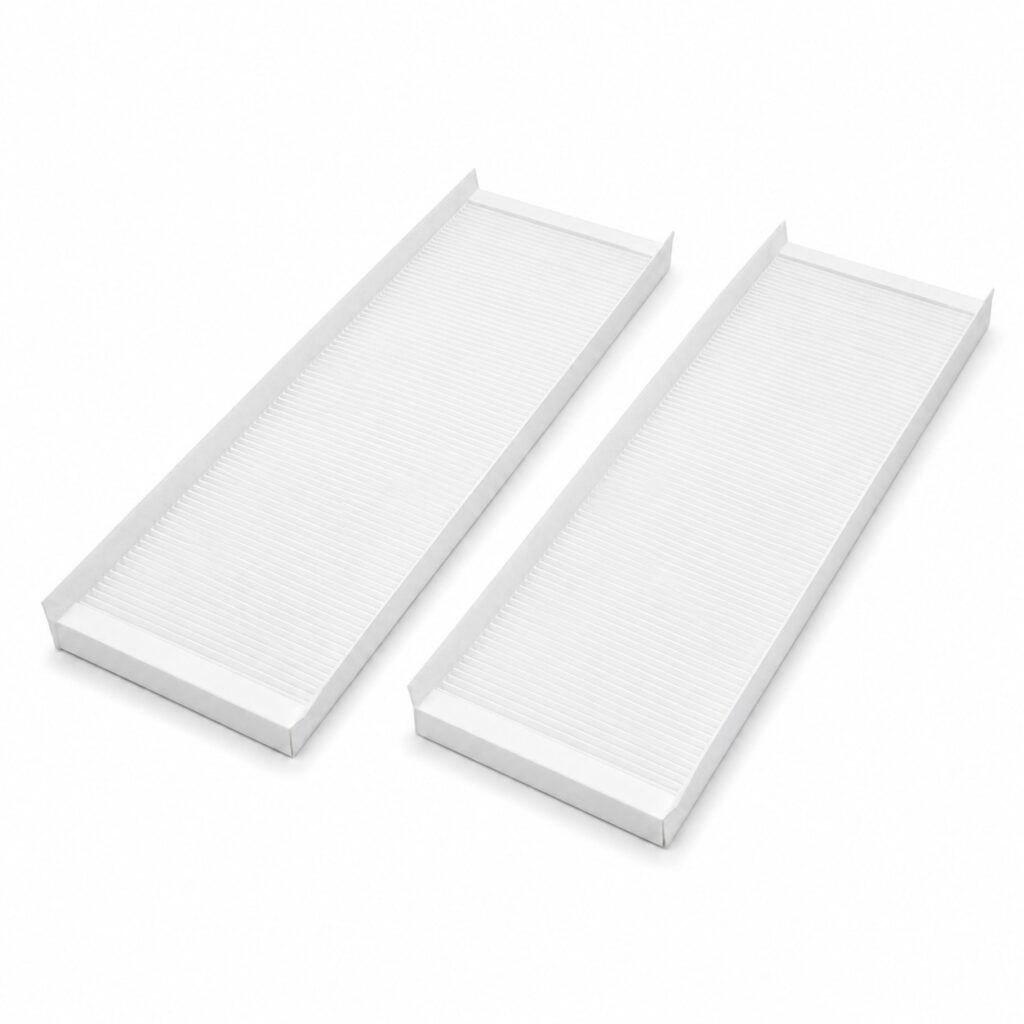
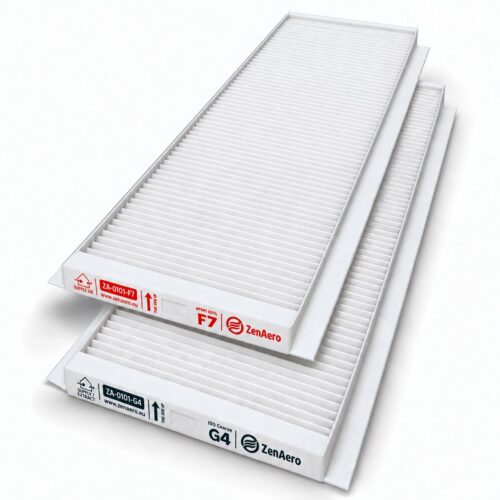
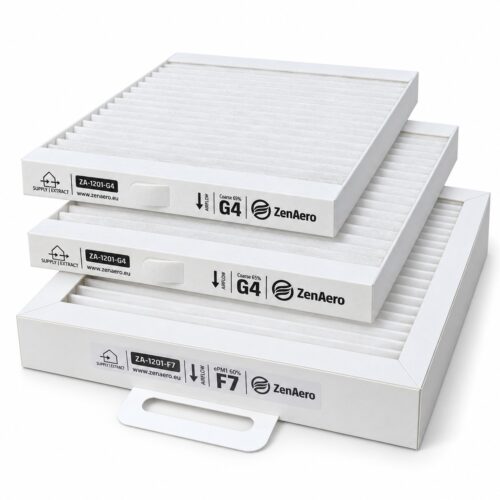
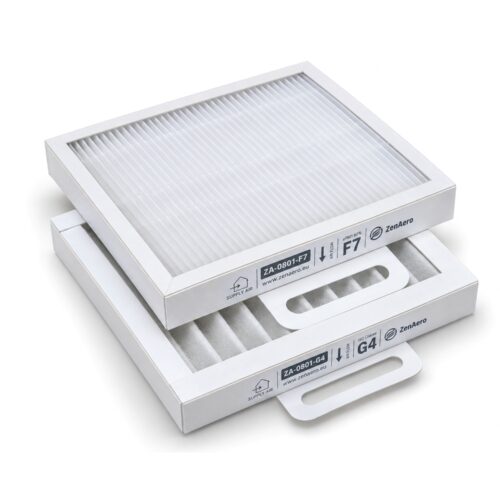
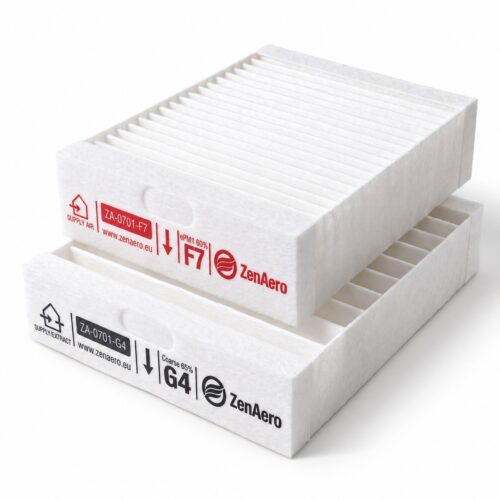
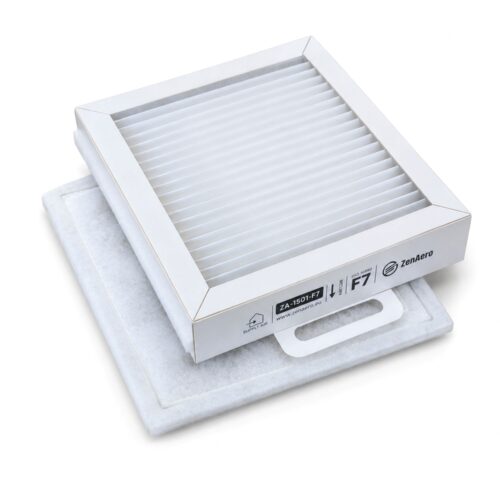
Different units solve the same question in different ways. The products below include an F7-type / ePM1 supply-air filter, but the set layout is not identical. Zehnder ComfoAir Q and Salda Smarty 2XP use a mixed F7 + G4 set, Brofer RDCD25SK / SH uses one fine filter plus two coarse filters, while Brink Sky uses a dedicated F7 supply filter beside reusable G4 media.
Check the complete model name before ordering. Brofer RDCD25SK / SH is not the same as every unit called RDCD25, and dimensions must match.
Select options
This product has multiple variants. The options may be chosen on the product page
Frequently asked questions
Is an F7 filter always better than a G4 filter?⌄
No. F7 gives finer filtration, but it normally has more resistance. G4 can be the better choice when the unit is designed for it, outside air is relatively clean and easy airflow is more important than fine-particle filtration.
Can I replace a G4 filter with an F7 filter?⌄
Only when the ventilation unit allows it. Check the manual, dimensions, sealing, supply-air position and the unit’s ability to handle the extra pressure drop.
Should F7 go on supply air or extract air?⌄
In many residential MVHR units, F7 goes on incoming supply air and G4 goes on extract air. This is common, not universal, so follow the filter label and unit manual.
Is G4 the same as ISO Coarse?⌄
G4 is an older EN 779 class and is commonly associated with ISO Coarse products. It is not a perfect one-to-one conversion, so read the actual ISO 16890 declaration and percentage.
Is every F7 filter ePM1 60%?⌄
No. F7 is an old class and different F7 filters can receive different ISO 16890 ratings. Check the full product declaration. ZenAero products listed as ePM1 60% state this directly on the product page and label.
Will F7 reduce the airflow of my MVHR unit?⌄
It can. In a variable-airflow system the delivered airflow may fall. In a constant-airflow system the fans may work harder to keep the set flow. The actual change depends on the filter and the unit.
Can G4 or F7 filters be washed?⌄
Normally no, unless the product is specifically sold as washable. Water, vacuuming or compressed air can damage disposable filter media and its structure.
Does an F7 filter remove smells?⌄
Not by itself. F7 is a particle filter. Odours and gases generally require activated carbon or another adsorption material designed for that purpose.
The simple decision rule
If G4 is allowed and the outdoor air already suits you, there is no need to upgrade only because F7 sounds more advanced. Choose a compatible F7-type filter when pollen or fine outdoor particles are a real concern and the ventilation unit has enough capacity for it. In mixed sets, F7 normally goes to supply air and G4 to extract air.
To provide the best experiences, we use technologies like cookies to store and/or access device information. Consenting to these technologies will allow us to process data such as browsing behavior or unique IDs on this site. Not consenting or withdrawing consent, may adversely affect certain features and functions.
Functional
Always active
The technical storage or access is strictly necessary for the legitimate purpose of enabling the use of a specific service explicitly requested by the subscriber or user, or for the sole purpose of carrying out the transmission of a communication over an electronic communications network.
Preferences
The technical storage or access is necessary for the legitimate purpose of storing preferences that are not requested by the subscriber or user.
Statistics
The technical storage or access that is used exclusively for statistical purposes.The technical storage or access that is used exclusively for anonymous statistical purposes. Without a subpoena, voluntary compliance on the part of your Internet Service Provider, or additional records from a third party, information stored or retrieved for this purpose alone cannot usually be used to identify you.
Marketing
The technical storage or access is required to create user profiles to send advertising, or to track the user on a website or across several websites for similar marketing purposes.