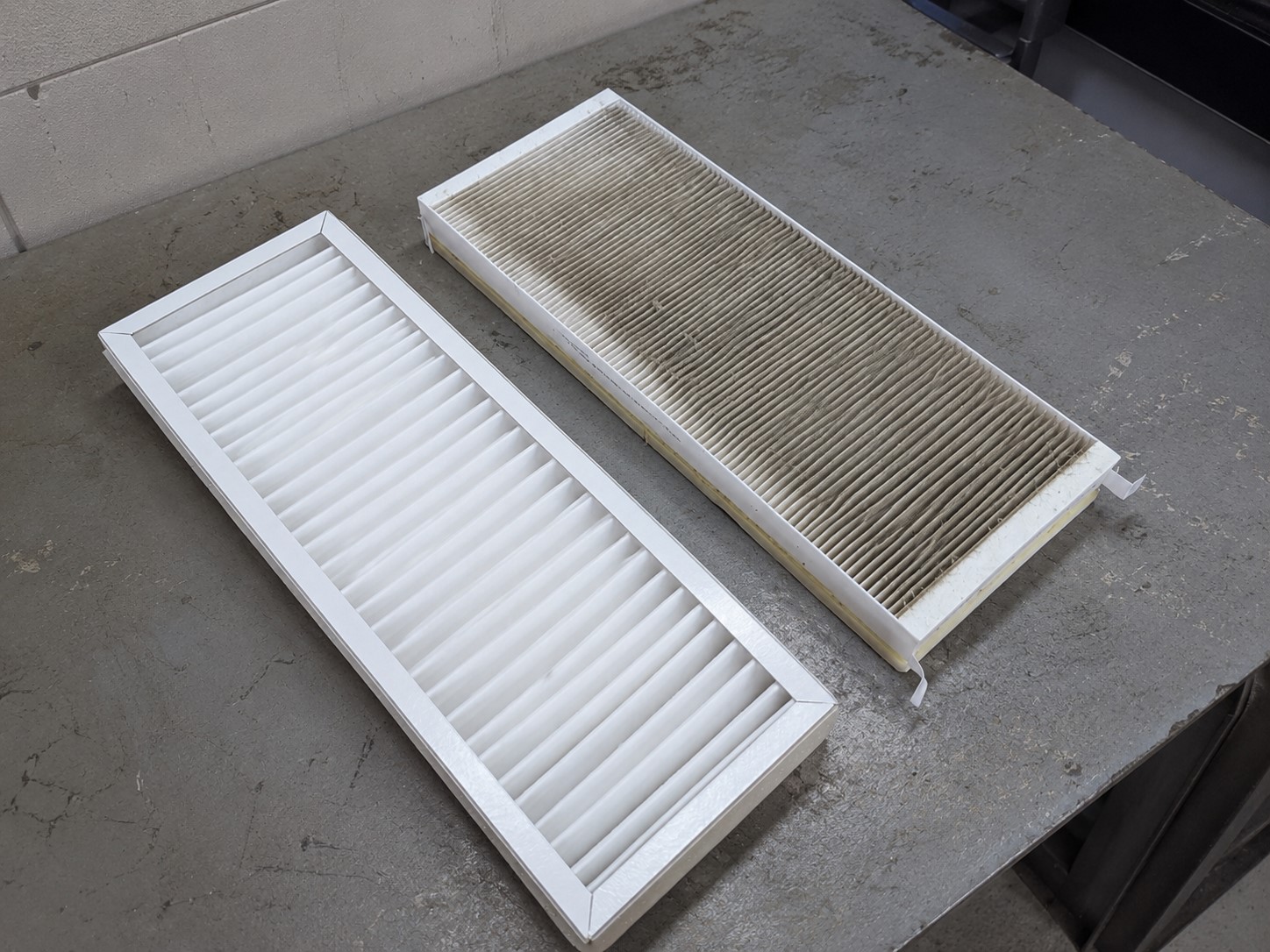
What Does a Ventilation Filter Actually Do?
A ventilation filter is one of the key components inside a residential ventilation unit.
Its main purpose is to protect the system from contamination and help maintain cleaner
indoor air.
The speed at which a filter becomes dirty depends mainly on three things:
outdoor air pollution, filter efficiency and how intensively the system is used.
The more polluted the air, the finer the filter and the higher the airflow, the sooner
the filter will need replacement.
Think of it like a vacuum cleaner filter. The difference is that most residential
ventilation units do not measure real filter dirt. They usually show a time-based
reminder after a fixed number of months.
Why Regular Filter Replacement Matters
⚡
Lower Energy Consumption
A dirty filter creates resistance. Fans need more power to push air through it.
🌬️
Better Airflow
Blocked filters reduce fresh air supply. This is often noticed in the morning or in closed bedrooms.
🛡️
System Protection
Dirty filters can lead to fan overload, reduced performance or ventilation unit errors.
🔧
Longer Unit Lifetime
Fans working against high resistance wear faster and operate less efficiently.
What Happens If the Filter Is Not Replaced?
If a filter is left in the unit for too long, the ventilation system may lose airflow,
become louder or start bypassing air through small gaps between the filter and the housing.
In that case, dust can reach the heat exchanger, fan impellers and internal components.
Organic particles collected on the filter can also become a source of unpleasant odours,
especially when humidity is high. This is one reason why a filter that looks “only dirty”
should not be ignored.
How to Know When a Ventilation Filter Is Dirty
Many ventilation units display a filter replacement reminder every 4–6 months. This is useful,
but it does not always show the real condition of the filter. In a clean rural area the filter
may last longer. In a city, near a busy road or during construction works, it may become dirty much faster.
- Reduced fresh air supply
- Stale or unpleasant odours
- More humidity or condensation indoors
- Higher noise from the ventilation system
- Filter alarm or service reminder on the unit
If you notice one of these signs, visually inspect the filters and replace them if needed.
How Often Should You Replace Ventilation Filters?
Filter lifetime depends on filter type, air pollution and system usage. As a general guide:
| Filter Type / Class | Typical Replacement Interval |
|---|
| Filter media pads or wire-frame filters | 2–3 months |
| G4 / Coarse filters | 6–8 months |
| M5–M6 / ePM10 filters | 5–7 months |
| F7–F8 / ePM2.5–ePM1 filters | 4–6 months |
| F9 filters | 3–4 months |
| Activated carbon filters | 2–4 months |
When Filters Need to Be Replaced More Often
You should check and replace filters more frequently if your home is exposed to higher
levels of dust, smoke or pollution.
- Living in a large city
- Living near a busy road
- Living near a gravel road
- Nearby construction works
- Industrial areas nearby
- Wood-burning smoke in winter
- Wildfire smoke
- Saharan dust or long dry periods
Do Original Filters Last Longer?
Not necessarily. The service life of a ventilation filter depends mainly on the filter media,
filter area, construction quality and air conditions — not only on whether it is original or
aftermarket.
A good quality replacement filter with comparable media can perform very similarly to an
original filter. Very cheap low-quality filters may have higher resistance, lower dust holding
capacity or weaker frames, which can reduce their useful lifetime.
Can You Use a Ventilation Unit Without Filters?
No. A ventilation unit should not be operated without filters. Running the system without
filters can contaminate the heat exchanger, fans and internal surfaces. It may also affect
warranty coverage if the unit is damaged or visibly contaminated.
Can Ventilation Filters Be Washed or Vacuumed?
Most ventilation filters should not be washed. Washing can damage the filter media and reduce
filtration efficiency.
Some simple filter pads or coarse wire-frame filters can be vacuumed a few times, but fine
filters such as ePM1, ePM2.5, F7, F8 or F9 should normally be replaced. Fine particles are trapped
inside the filter layers and cannot be removed properly with a vacuum cleaner.
Need Replacement Ventilation Filters?
We supply replacement filters for residential ventilation units in different sizes,
filter classes and configurations.
Request a Filter QuoteFAQ: Ventilation Filter Replacement
How often should I change ventilation filters?
In most residential ventilation units, filters are changed every 4–6 months.
Coarser filters may last longer, while fine filters and activated carbon filters usually
need replacement more often.
How often should I change MVHR or HRV filters?
MVHR and HRV filters are usually replaced every 4–6 months, depending on air pollution,
filter class and ventilation intensity. Homes near roads, cities or construction sites
may need more frequent replacement.
What are the symptoms of a dirty ventilation filter?
Common symptoms include lower fresh air supply, stale odours, increased humidity,
higher noise from the unit and filter replacement warnings on the controller.
Can I wash ventilation filters?
No. Most ventilation filters should not be washed because water can damage the filter
media and reduce filtration performance.
Can I vacuum ventilation filters?
Simple coarse filter pads may be vacuumed a few times, but fine filters such as F7, F8,
F9, ePM1 or ePM2.5 should be replaced rather than vacuumed.
Can I run my ventilation unit without filters?
No. Running a ventilation unit without filters can contaminate the heat exchanger,
fans and internal components. It may also create warranty problems.
Are original ventilation filters better than replacement filters?
Original filters are not always necessary. A high-quality replacement filter with similar
filter media and proper fit can provide comparable performance. The important factors are
filter class, pressure drop, construction quality and correct dimensions.
Why does my ventilation unit show a filter alarm?
In most residential units, the filter alarm is a time-based reminder. It does not always
measure the real dirt level. Some advanced systems use pressure sensors or other indicators,
but visual inspection is still useful.