F7 Filter Explained: What It Captures, Where It Goes and When to Use It
An F7 filter helps reduce pollen, fine dust and PM1/PM2.5 particles in incoming MVHR air. This practical guide explains where the filter goes, how F7 compares with G4 and activated carbon filters, and when it should be replaced.
F7 filter explained without the filter-class jargon
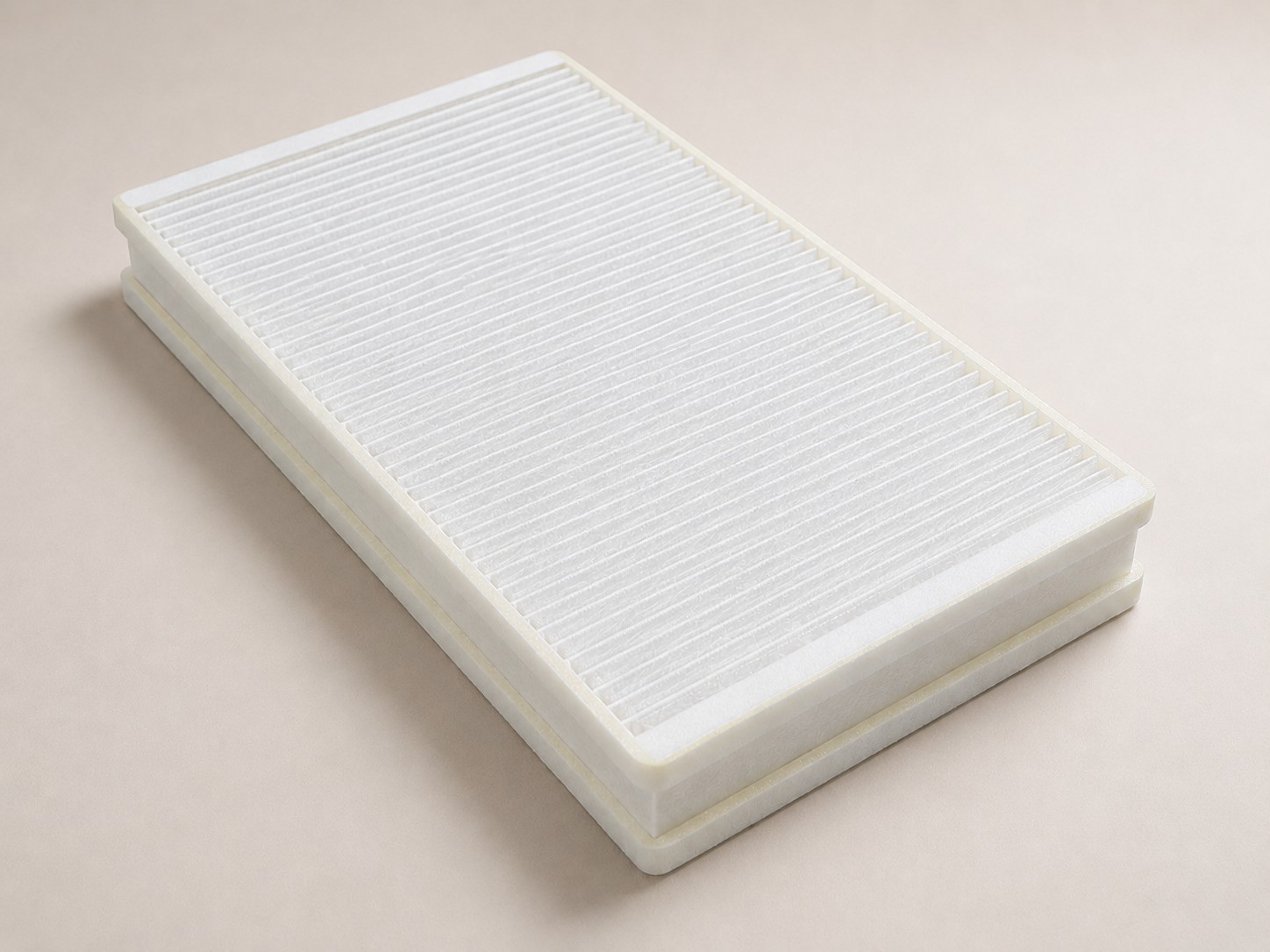
An F7 filter is the fine-particle filter used on the incoming-air side of many MVHR and heat recovery units. Its job is to reduce pollen, fine dust and a meaningful share of PM10, PM2.5 and PM1 before outdoor air reaches your rooms.
This guide shows where it goes, what the percentages mean, when it is worth using and when an activated carbon filter is the better answer.
✓
The short practical answer
Use an F7 or tested ePM1 filter on incoming supply air when pollen and fine outdoor particles are the problem. Use G4 or ISO Coarse mainly for unit protection. If smoke or traffic smell is the problem, choose a compatible combination filter with activated carbon and expect a shorter 2–3 month useful life.
What is an F7 filter?
F7 is the familiar name from the older EN 779 classification. The letter F meant fine filtration, and 7 was the class number. You will still find F7 in older ventilation manuals, replacement-filter lists and normal product searches.
The current ISO 16890 system uses labels such as ISO Coarse, ePM10, ePM2.5 and ePM1. Instead of one letter and number, it identifies the tested particle-size fraction and the measured efficiency group. That makes a label such as ePM1 60% more useful than F7 alone.
G4Legacy coarse filter
M5–M6Legacy medium range
F7–F9Legacy fine filters
ISO 16890Coarse, ePM10, ePM2.5, ePM1
F7 and ePM1 are not automatically the same. Old F7 products can sit roughly between ePM2.5 60% and ePM1 60%. Read the exact ISO 16890 result for the complete filter, not only the old F7 label.
What does ePM1 60 percent mean?
An ePM1 60% filter achieved 60% efficiency for the standardized PM1 fraction in the laboratory test. PM1 covers particles with an optical diameter from 0.3 to 1 micrometre. Real-life performance also depends on airflow, installation, outdoor air and filter loading.
For a tested high-performing F7 replacement, the practical figures can look like this:
>99.8%coarse pollen-sized particles
about 90%PM10 fraction
about 75%PM2.5 fraction
at least 60%PM1 fraction for ePM1 60%
These figures belong to a tested filter with that performance. They are not a universal promise for every product sold under the old F7 name.
An F7 filter is a particle filter. Installed on the incoming-air side, it can reduce the amount of airborne particles entering the home. It does not remove gases, VOCs or odours.
🌼
PollenLarge seasonal airborne pollen particles
🚗
Traffic particlesBrake, tyre and road dust — not exhaust gases
🔥
Combustion particlesFine particles from wood burning and heating smoke
🌫️
Smog particlesParticulate pollution — not the gaseous components
◉
Mould sporesAirborne spores entering with outdoor air
✦
Fine dustA meaningful share of PM10, PM2.5 and PM1
🌾
Agricultural dustField and pesticide dust particles — not pesticide vapours
💧
Respiratory dropletsSome particle carriers released by coughing or sneezing
Important: an F7 filter reduces particle exposure; it does not disinfect the air and cannot guarantee protection from infection.
Where does the F7 filter go?
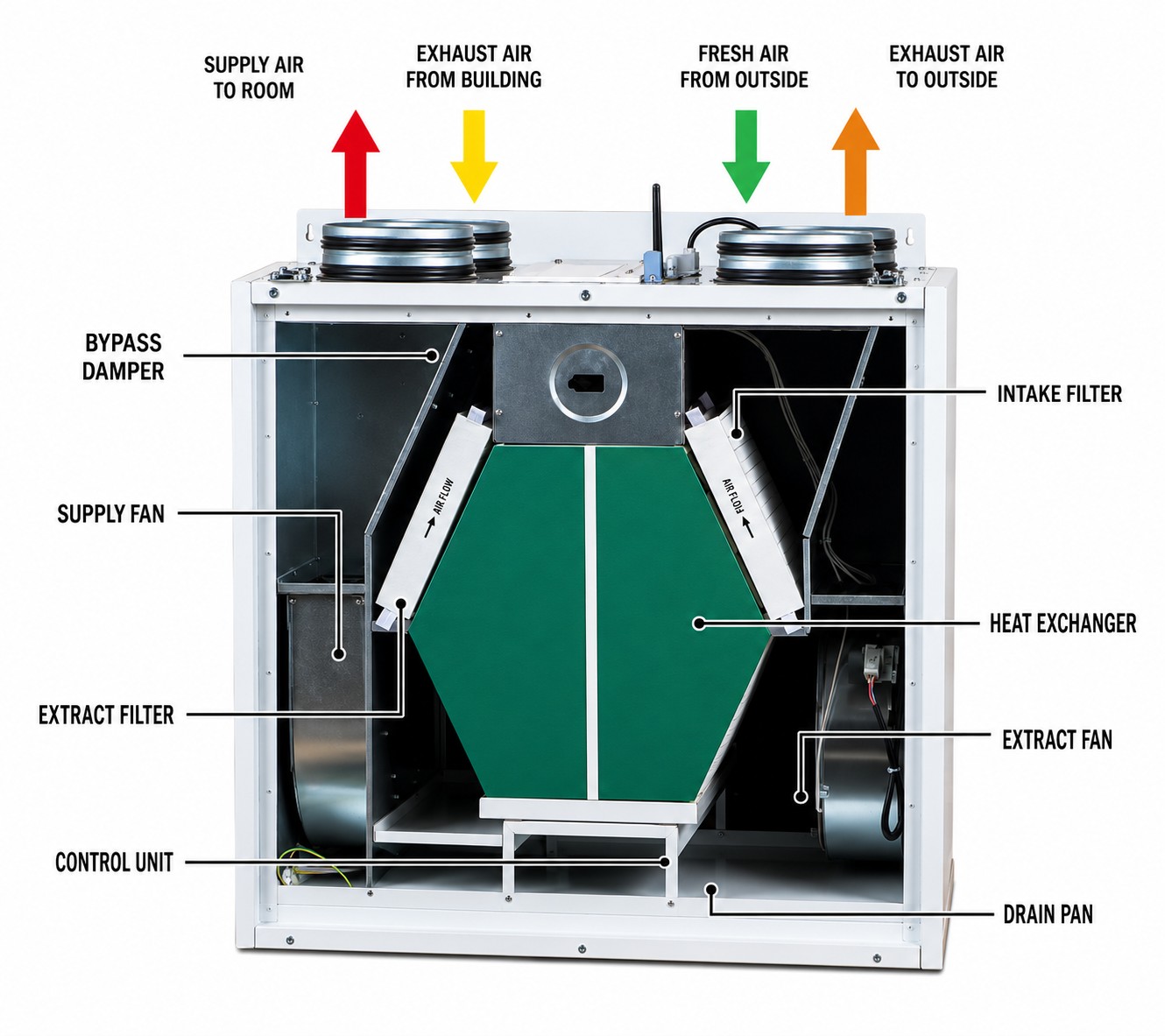
In the usual residential arrangement, F7 goes on the incoming outdoor-air or supply-air side. It filters air before it passes through the unit and enters bedrooms and living spaces. The extract-air filter catches household dust before extracted indoor air reaches the heat exchanger.
Typical MVHR layout: the F7 filter cleans incoming outdoor air before the heat exchanger, while a G4 or ISO Coarse filter commonly protects the extract-air side. Always follow the unit labels and manual.
Outdoor airPollen, road dust and combustion particles
→
F7 or ePM1Fine-particle supply filter
→
RoomsFiltered supply air enters the home
Indoor extract airDust from rooms, kitchen and bathroom
→
G4 or CoarseProtects the extract side and heat exchanger
→
Exhaust airAir leaves the building
This is the common F7 + G4 arrangement, not a universal rule. Some units use F7 on both sides. Follow the model diagram and labels.
Install the filter in the direction shown by the arrow on the frame or unit. If it is fitted backwards, the pleats and support structure may not work as designed, which can cause uneven loading and shorten the filter’s useful life.
2. Make sure the filter seals properly
If there are gaps between the filter and its holder—or openings around the filter frame—air will take the easier path around the filter media. Part of the air will then remain unfiltered, so the F7 classification provides little benefit.
F7 compared with G4 M5 F9 carbon and HEPA
Filter
Main job
Practical particle guide
Typical use
Main drawback
G4 / ISO Coarse
Protects the unit from insects, fluff and large dust
Often under 5% for PM2.5
Extract side or pre-filter
Very limited fine-particle capture
M5 / ePM10
Intermediate particle filtration
Often 50–70% PM10 and up to about 15% PM2.5
Middle option
Weak on the finest particles
F7 / ePM1
Pollen and fine particles
A tested ePM1 60% example may reach about 75% PM2.5 and 90% PM10
Incoming supply air
More resistance and cost than G4
F9
Higher fine-particle efficiency
Often starts around ePM1 85%
Very polluted locations when approved
Higher resistance
Carbon combination
Particles plus odours and some gases
Often ePM10 or ePM2.5 media with carbon fibre
Smoke and traffic odours
Usually weaker fine-particle capture and short carbon life
HEPA
Very high particle filtration
Separate high-efficiency classification
Systems designed for HEPA
Too much resistance for most residential MVHR units
F7 filter versus activated carbon filter
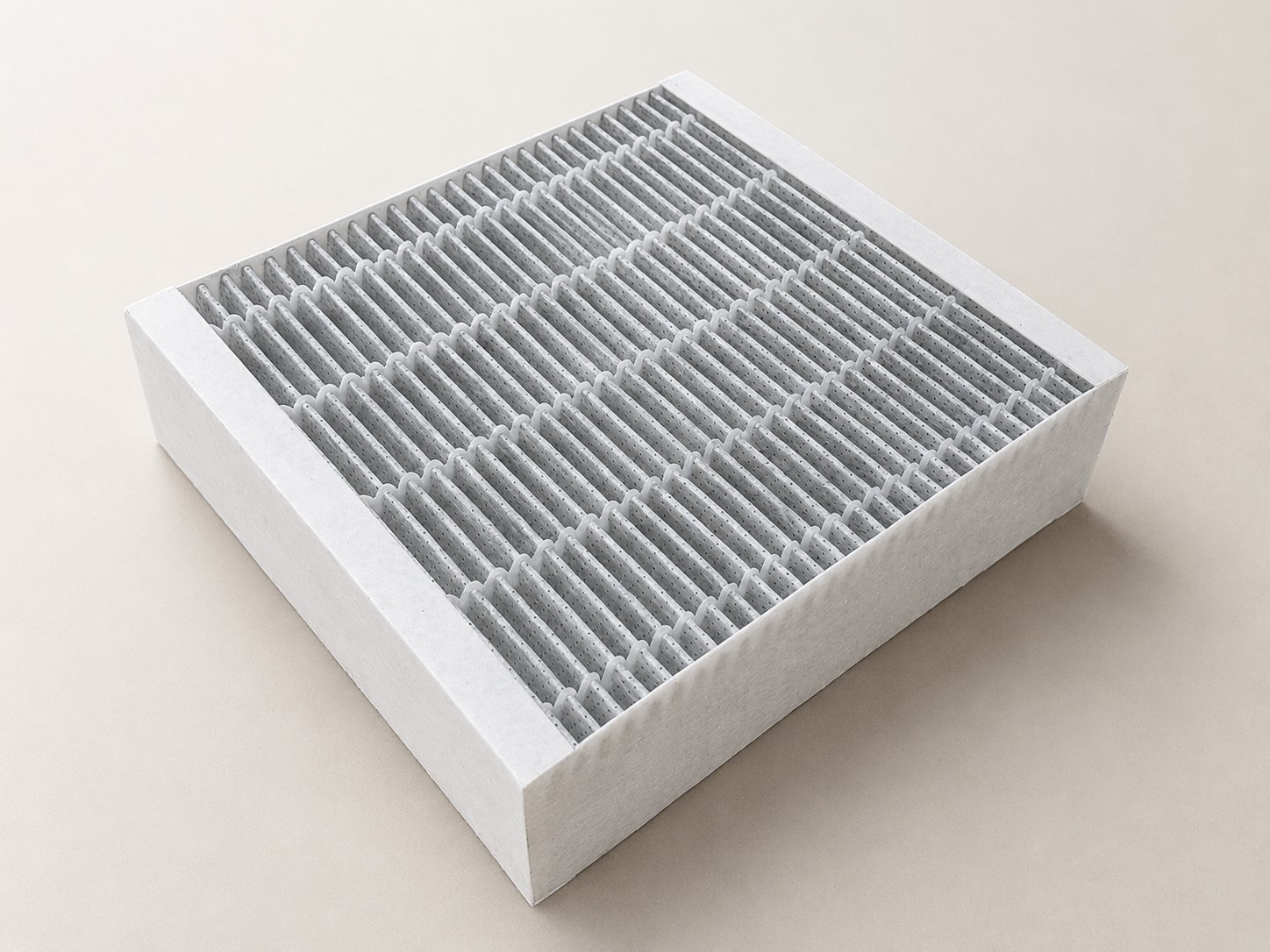
An activated carbon filter for a residential MVHR unit is normally a combination filter, not a block of carbon and not a separate cassette filled with carbon. Like many automotive cabin filters, it uses ePM10 or ePM2.5 filter media manufactured with activated carbon fibre integrated into the material. The same pleated medium catches solid particles while the carbon fibre adsorbs part of the odours and gaseous pollutants.
F7 / ePM1 filterDense white particle-filter media for pollen and fine particulate pollution.Carbon combination filterThe grey pleated material itself contains activated carbon fibre; there is no separate tray filled with carbon.
Choose F7 or ePM1
Your main problem is pollen, fine road dust, PM2.5 or combustion particles.
Choose carbon combination
Your main complaint is wood-smoke smell, traffic exhaust smell or other outdoor odours.
Know the compromise
The particle media may be ePM10 or ePM2.5 rather than ePM1, so fine-particle capture can be lower than with F7.
Carbon has limited adsorption capacity. Once saturated, it stops holding odour molecules effectively even if it does not look dirty. 2–3 months is a sensible practical replacement interval for many thin carbon-fibre filters.
When will you notice the benefit?
Changing from G4 to F7 is most relevant near busy roads, city centres, industry or construction, and where solid fuel is burned during the heating season. It is also useful during pollen season.
Do not expect an immediate smell or dramatic overnight feeling. PM2.5 and PM1 pollution is often invisible and odourless. If smell is the only problem, use carbon rather than expecting F7 to solve it.
Balanced ventilation works continuously in the background. The filter determines what is removed before incoming air reaches the rooms.
F7 is useful when the unit can actually breathe through it
If a unit was designed only for G4, extra resistance can reduce airflow, increase fan noise, trigger an error or leave the home under-ventilated.
How to choose the correct F7 replacement
Start with the exact MVHR make and model. A model search is safer than guessing from appearance.
Compare the original code and dimensions. Length, width, thickness and frame construction all matter.
Read the tested class. Prefer a clear ISO 16890 declaration such as ePM1 60%.
Confirm the filter position. F7 normally belongs to incoming supply air, but the unit diagram decides.
Check sealing and airflow direction. The frame must fit without gaps.
Watch the system after an upgrade. Check airflow, fan noise and alarms.
Avoid unknown-origin filters without a test declaration. Also avoid stretching a small sheet of F7 media over a wire frame: too little surface area creates high resistance.
Practical starting interval under normal residential conditions.
2–3 months
High particle load: busy roads, construction dust, heating-season smoke or a strong pollen season.
Check sooner
Inspect the filter after an airflow warning, increased fan noise or visibly heavy loading.
Check earlier if airflow falls, fan noise increases, a warning appears, rooms feel stale or condensation starts appearing. Do not judge only by colour because fine particles load inside the media.
Residential F7 filters are disposable. Vacuuming does not restore the inner media; washing or compressed air can damage it.
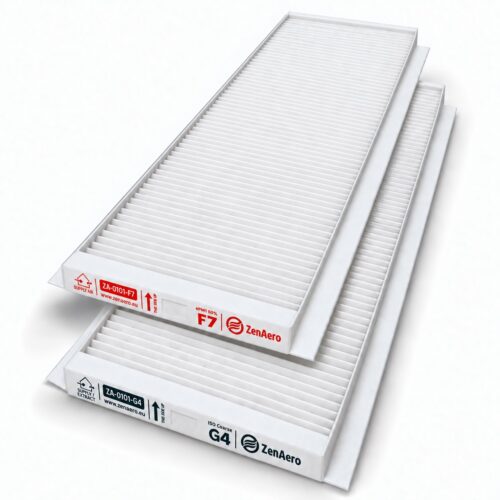
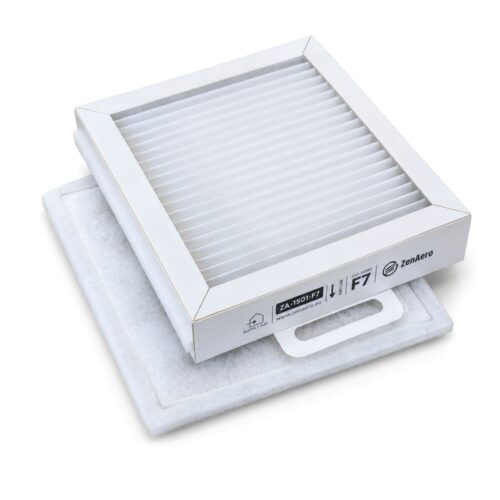
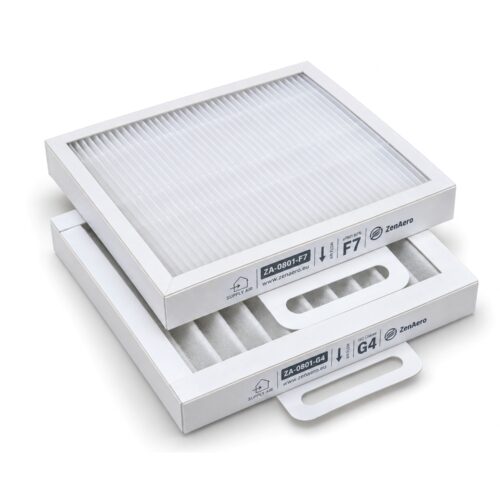
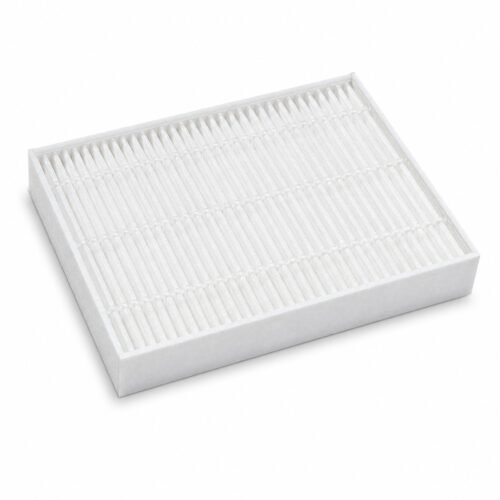
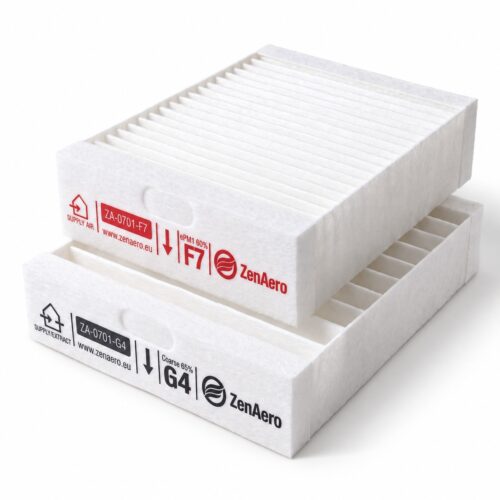
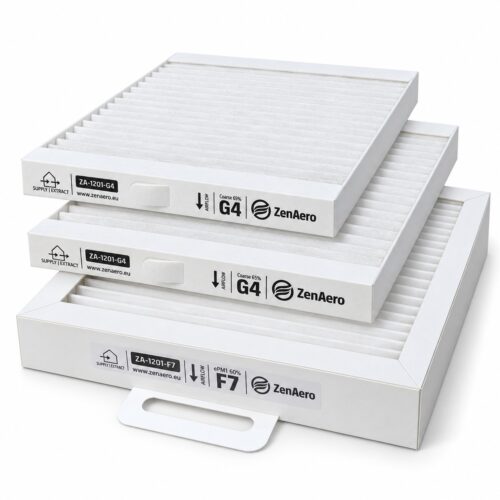
These examples use fine supply-air filtration, but their set layouts differ. Check the complete model name, dimensions and number of filters before ordering.
No. F7 belongs to EN 779 and ePM1 to ISO 16890. Read the exact tested label.
Can I replace G4 with F7?⌄
Only when the unit allows a fine-filter option and has enough fan pressure.
Which side takes F7?⌄
Normally the incoming outdoor-air or supply side. Follow the model diagram.
Does F7 remove pollen?⌄
Yes. Pollen is one of the main reasons to use F7 on supply air.
Does F7 remove smoke or exhaust smell?⌄
Not effectively. Use a compatible activated carbon combination filter.
How long does a carbon filter last?⌄
Many thin residential carbon-fibre filters are most useful for about 2–3 months.
Can I wash or vacuum F7?⌄
No. These methods do not restore the loaded inner media and can cause damage.
The practical decision
Choose F7 or tested ePM1 when pollen and fine particulate pollution are the problem and your unit supports the resistance. Choose a carbon combination when odour and gaseous pollution are the complaint. Use G4 for unit protection where the design calls for it.
To provide the best experiences, we use technologies like cookies to store and/or access device information. Consenting to these technologies will allow us to process data such as browsing behavior or unique IDs on this site. Not consenting or withdrawing consent, may adversely affect certain features and functions.
Functional
Always active
The technical storage or access is strictly necessary for the legitimate purpose of enabling the use of a specific service explicitly requested by the subscriber or user, or for the sole purpose of carrying out the transmission of a communication over an electronic communications network.
Preferences
The technical storage or access is necessary for the legitimate purpose of storing preferences that are not requested by the subscriber or user.
Statistics
The technical storage or access that is used exclusively for statistical purposes.The technical storage or access that is used exclusively for anonymous statistical purposes. Without a subpoena, voluntary compliance on the part of your Internet Service Provider, or additional records from a third party, information stored or retrieved for this purpose alone cannot usually be used to identify you.
Marketing
The technical storage or access is required to create user profiles to send advertising, or to track the user on a website or across several websites for similar marketing purposes.