An F9 filter requires a heat-recovery unit that permits its use and an installation with sufficient pressure reserve at the required airflow. Approval for the unit does not remove the additional resistance: particularly in systems already close to their limit, changing from F7 to F9 can increase noise and power consumption, reduce airflow and bring forward filter replacement. Assess the complete system.
Heat-recovery ventilation units are designed to operate across a range of airflows and pressures. Their actual operating point depends on the ducts, terminals and system settings. A correctly sized compatible filter with specifications suitable for the unit does not damage it simply because it is not an original part. Dimensions, sealing, filtration class and airflow resistance all matter. Maintenance makes the difference: a heavily loaded filter increases resistance and may reduce airflow or make the fans work harder to maintain it. Regular replacement helps keep the system working properly.
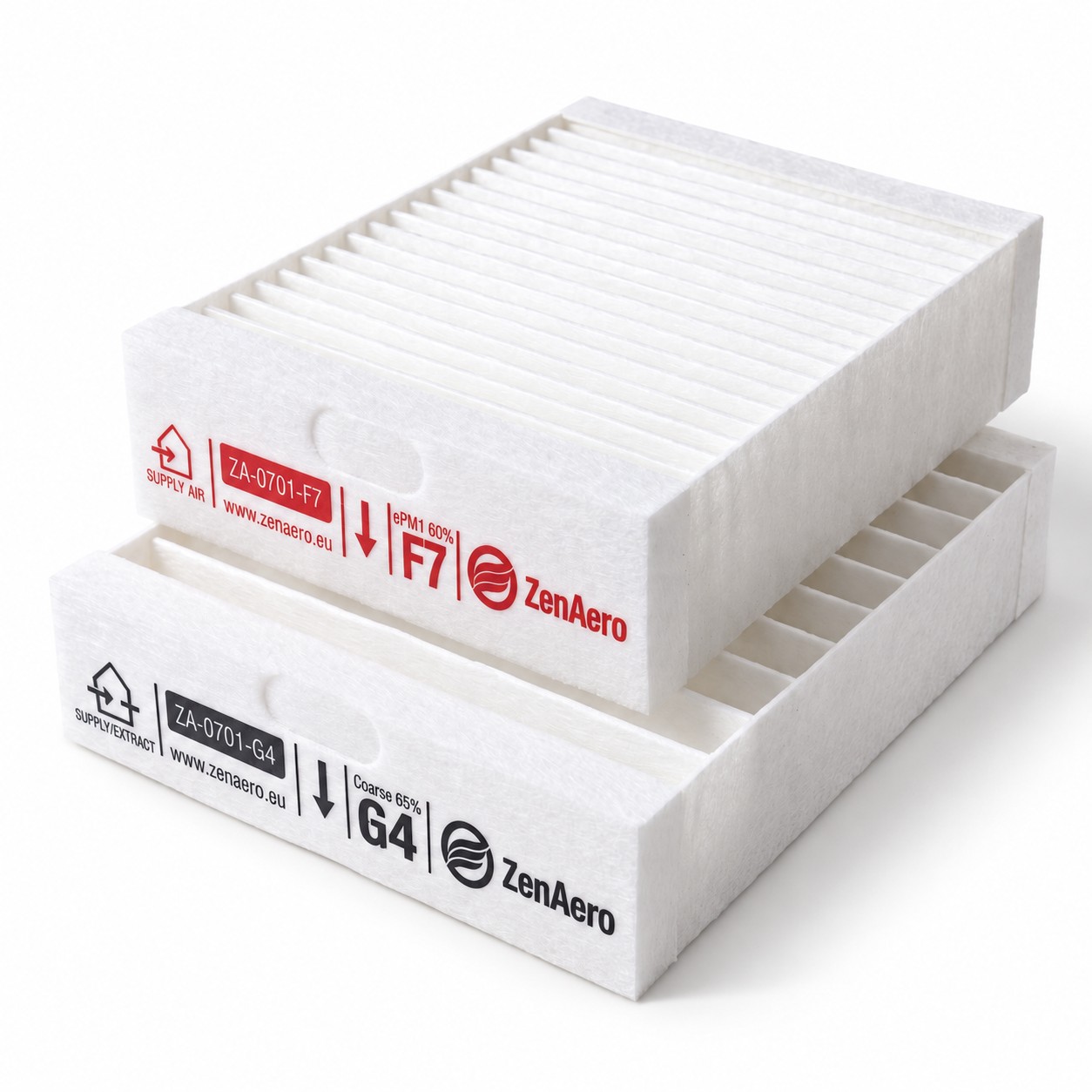
Catalogue example: compatible ZenAero F7 + G4 set for Siber DF EVO, 139 × 175 × 48 mm. This image shows F7 and G4; it is not a photographic F7/F9 comparison.
In brief
ISO 16890 rates performance against PM1, PM2.5 and PM10. The relationship with EN 779 classes is indicative; check the product’s declared ePM rating.
Compare declared filtration efficiency and pressure drop at the same airflow. Class alone does not determine airflow resistance.
F9 must be permitted for the unit. Its typically higher resistance than a similarly constructed F7 can increase noise and energy use or reduce airflow when the installation has little reserve.
Before ordering, check the unit code, all three dimensions, position and flow direction. Non-standard dimensions may require an assessed custom replacement.
Replacement intervals depend on filter condition, outdoor air and operation. Follow the filter and equipment instructions for cleaning or washing.
F7 and F9 originate from the former EN 779 standard. ISO 16890 classifies filters by particle-fraction efficiency: PM1, PM2.5 and PM10. Eurovent’s filter-selection guidance focuses on the required protection against outdoor pollutants.
These standards use different tests, so there is no universal conversion. To compare two replacements, read each product’s ISO rating and technical data.
F7 and F9: what to compare before ordering
Item
Check for both filters
Efficiency
Declared ISO 16890 class and percentage; F7 or F9 alone is not the full specification.
Airflow resistance
Pressure drop in Pa at the same airflow in m³/h, dimensions and test conditions.
Compatibility
Complete unit model, width, height, thickness, sealing and permitted class.
Appearance
A photograph cannot demonstrate filtration class or efficiency.
Pressure drop and airflow: assess the installation
The unit manufacturer must permit F9 for the specific model. Physical fit is not sufficient: check the requested airflow, available fan pressure and the resistance of the entire installation.
With comparable dimensions, construction and airflow, moving from F7 to F9 generally increases airflow resistance. This still matters when the unit accepts F9. Media, filtering area and pleat geometry can change the outcome; quantify it using data for the actual filters at the same airflow.
Permitted F9 does not guarantee comfort in every installation
If the system already operates near the unit’s pressure or airflow limit, a more resistant filter can use up the remaining reserve. Long or narrow ducts, numerous bends, restrictive terminals and poor balancing make the check more important.
More noise: a constant-flow unit may raise fan speed to compensate, increasing perceived noise.
Higher electricity use: maintaining airflow against greater resistance can require more power.
Lower airflow: when the fan can no longer compensate, ventilation can fall below the required rate.
Possibly earlier replacement: with little initial pressure reserve, the resistance added by dirt may require earlier intervention. Actual service life depends on the filter, outdoor air and operating thresholds.
Have actual airflow, balancing, noise and electrical consumption checked before and after changing class. The relevant comparison is the real operating point, not simply the unit’s maximum stated airflow.
Keep the examples separate: the Siber DF EVO 2 technical page lists an F9 accessory. The consulted Brink Renovent Sky 300 manual lists G4 and F7 replacements and shows acoustic and electrical performance at different airflows and pressures. Do not transfer an F9 approval from one family or variant to another.
The ASHRAE filtration FAQ, written in the COVID-19 context and mainly discussing MERV, highlights system capability: increased resistance may reduce airflow or increase fan energy. It is not a blanket approval of F9 for residential MVHR units.
Use the filter data sheet and ventilation-unit documentation to check pressure drop and limits. Consult a technician before upgrading an F7-based system if the reserve is uncertain. Even when keeping the specified class, follow the equipment instructions. A well-seated filter and sound seals matter: gaps allow unfiltered air to bypass the media.
A checklist for choosing F7 or F9
Start with the unit: check permitted classes, then assess outdoor pollution and required efficiency.
Read the technical sheet: identify recommended filters and the permitted pressure-drop range.
Prefer the declared ISO 16890 rating: EN 779 correspondence is indicative, not universal.
Consider an assessed custom filter for non-standard dimensions.
Our product sheets state the particular filter rating, such as ePM1 60% (F7). Some kits combine two classes, for example F7 + G4; check the pack composition before ordering and search the catalogue by exact model.
How to identify and replace the correct filter
Find the filter code or the unit’s full model designation. If necessary, measure the existing element in three dimensions, then compare its class with the unit’s requirements.
Switch the unit off and open the filter access according to its manual.
Remove the old element, noting airflow direction.
Insert the replacement in the correct position and direction.
Close the access and check the frame and seals leave no bypass gaps.
There is no interval suitable for all installations: filter type, outdoor air and operating conditions determine how quickly it loads. When to replace ventilation filters. For unusual dimensions or equipment, ask about Custom-made ventilation filters. Seek technical help if safe filter access is uncertain.
Why choose ZenAero filters?
Our aim is to offer European-quality compatible filters, effective filtration and good value. At ZenAero, the value of a replacement lies in its materials, careful assembly and suitability for the ventilation system.
European quality: filters made in the EU, selected materials and careful assembly, with frames designed to fit their intended housing precisely.
Value compared with original replacements: an alternative designed to reduce maintenance costs without paying for the ventilation-unit manufacturer’s branding. Compare prices for the same model, class and number of filters per pack.
F7 / ePM1 60% for supply air: products carrying this rating help capture fine smog particles, soot, pollen and other particles that can carry allergens.
Filtration and airflow: our F7 filters are designed to balance fine-particle efficiency with air permeability, supporting regular ventilation operation.
Maintenance that protects your system: a suitable replacement changed at the right time avoids prolonged operation with a clogged filter. Service life depends on outdoor air, airflow and operating conditions.
The ePM1 60% declaration describes efficiency against PM1 particles under ISO 16890; it does not mean that every particle or allergen is removed. Choose the set specified for your model and maintain it according to the unit’s instructions.
Find a compatible filter for your ventilation unit
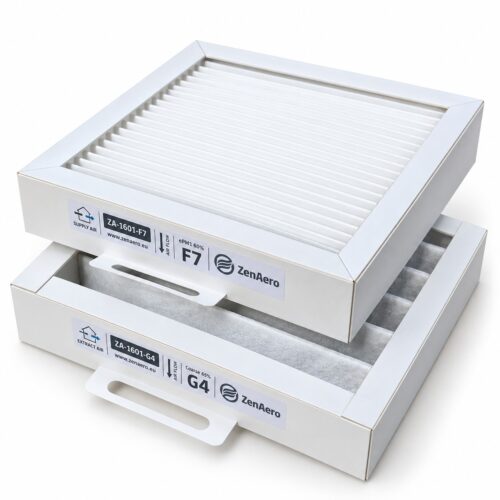
Examples of sets containing an F7 filter from the ZenAero catalogue. These are F7 + G4 sets, not F9 filters. The Siber DF EVO set measures 139 × 175 × 48 mm; the Aerauliqa QR180/QR230E set measures 200 × 200 × 46 mm. They are not interchangeable.
Select options
This product has multiple variants. The options may be chosen on the product page
Search the ZenAero catalogue by make and model and read each product’s declared rating. If your dimensions are absent, request a custom-filter quotation. Check the current product page for availability and pricing, and contact us if you need help assessing F7 versus F9 for your unit.
Frequently asked questions
What is the main difference between F7 and F9?
They are former EN 779 classes with different efficiency requirements. Compare the specific products’ ISO 16890 declarations for PM1 and PM2.5 performance. Airflow resistance needs a separate comparison at the same airflow.
Can I install F9 instead of F7?
Only if F9 is permitted for your exact unit and the installation retains adequate pressure reserve at the required airflow. Even an approved F9 can increase noise and energy use or reduce airflow near the system limit. Check dimensions, pressure drop, the fan curve and actual performance after fitting.
Can F7 and F9 filters be washed?
Pleated and pocket filters used in residential ventilation are generally not designed for washing. Follow the filter and unit manufacturers’ instructions for that particular element.
How do I identify the existing class?
Read the markings on the filter and the unit’s technical sheet. If they are missing, record the unit model and measurements and ask us to help identify the compatible replacement.
All trademarks belong to their respective owners and are used only to identify equipment and replacement compatibility. ZenAero compatible filters are not original parts from the ventilation-unit manufacturer. Before ordering, check the full model, dimensions and product specifications.
Manage Consent
To provide the best experiences, we use technologies like cookies to store and/or access device information. Consenting to these technologies will allow us to process data such as browsing behavior or unique IDs on this site. Not consenting or withdrawing consent, may adversely affect certain features and functions.
Functional
Always active
The technical storage or access is strictly necessary for the legitimate purpose of enabling the use of a specific service explicitly requested by the subscriber or user, or for the sole purpose of carrying out the transmission of a communication over an electronic communications network.
Preferences
The technical storage or access is necessary for the legitimate purpose of storing preferences that are not requested by the subscriber or user.
Statistics
The technical storage or access that is used exclusively for statistical purposes.The technical storage or access that is used exclusively for anonymous statistical purposes. Without a subpoena, voluntary compliance on the part of your Internet Service Provider, or additional records from a third party, information stored or retrieved for this purpose alone cannot usually be used to identify you.
Marketing
The technical storage or access is required to create user profiles to send advertising, or to track the user on a website or across several websites for similar marketing purposes.