Pollen and dust, or fine particles from traffic as well? ePM10 and ePM1 meet different filtration needs. See what changes in the air entering your home and find the right filter for your ventilation unit.
✓
The quick answer
ePM10 helps reduce pollen, spores and road or mineral dust. For finer filtration of particles from smog, traffic and combustion, look for ePM1. Choose a compatible size and a class suitable for your unit.
ePM1 and ePM10, simply explained
The label identifies the particle fraction used to assess the filter. PM10 includes particles up to 10 micrometres; PM1 refers to finer particles up to 1 micrometre. PM10 also includes fine particles, so an ePM10 filter does more than catch visible dust.
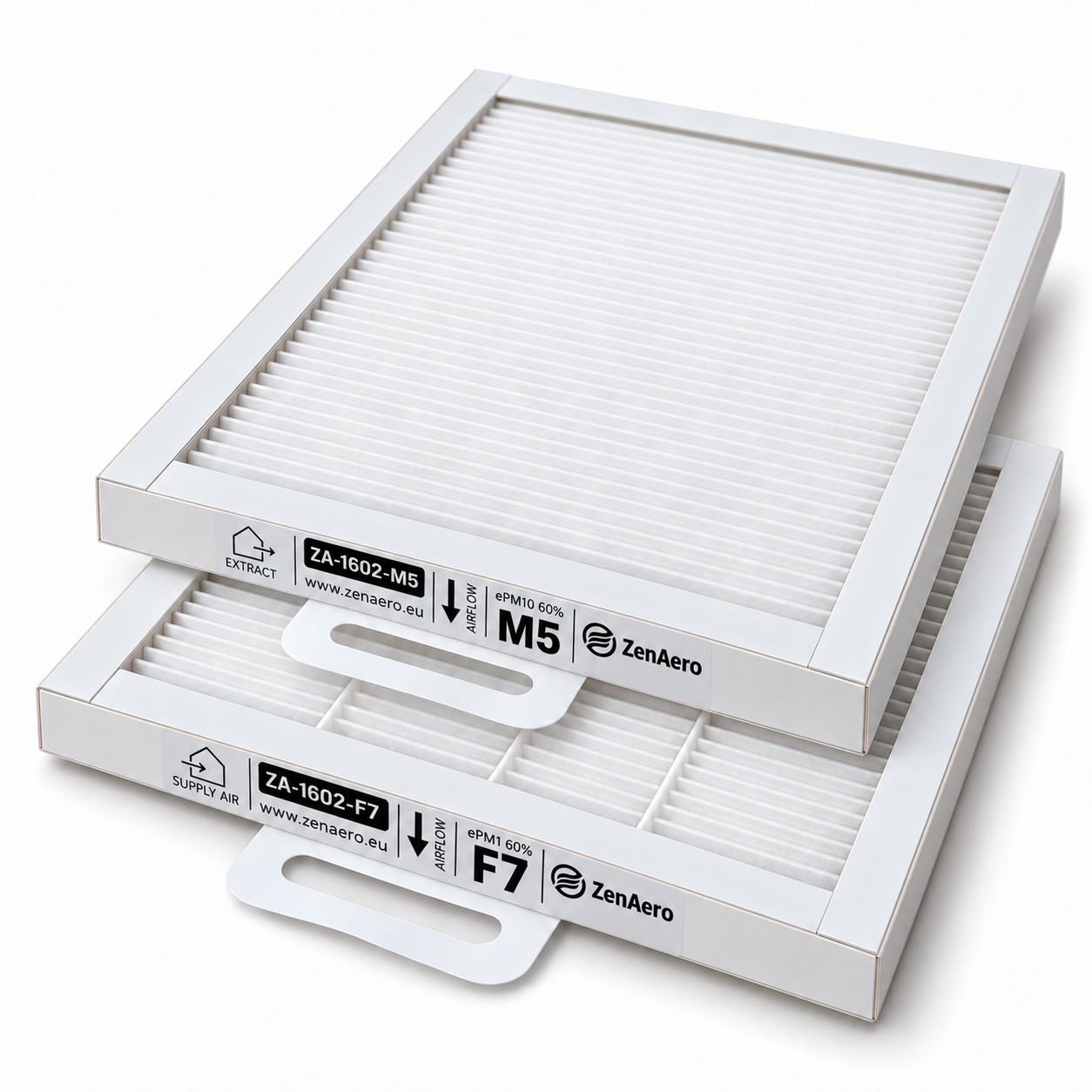
The percentage is the declared efficiency for that fraction. The ZenAero examples below are ePM10 60% (M5) and ePM1 60% (F7): the two 60% figures refer to different particle fractions.
What do they filter? See the difference
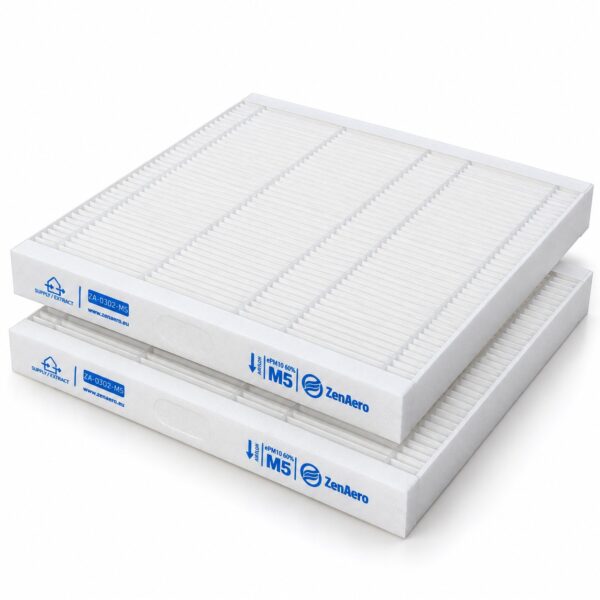
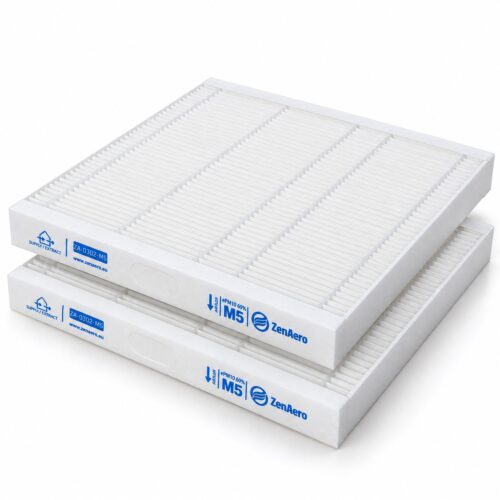
ePM10 60% · M5
Pollen and dust from outdoors
An ePM10 filter helps reduce pollen, mould spores, PM10 and road or mineral dust. It offers balanced filtration when these are the main particles you want to reduce.
M5 + M5 set: two ePM10 60% filters, 227 × 212 × 24 mm.
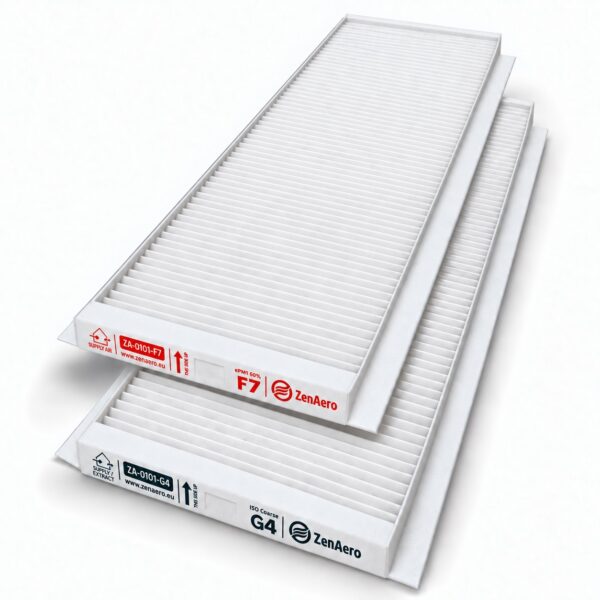
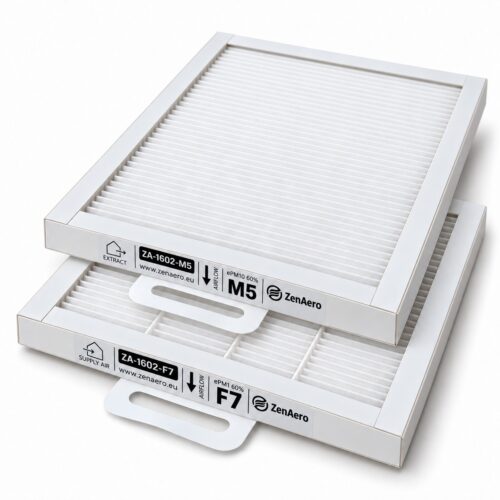
ePM1 60% · F7
Finer filtration for the air in your home
An ePM1 filter also reduces fine PM1 / PM2.5 particles and particles from traffic and combustion, alongside pollen and spores. It is particularly useful near busy roads and during the heating season.
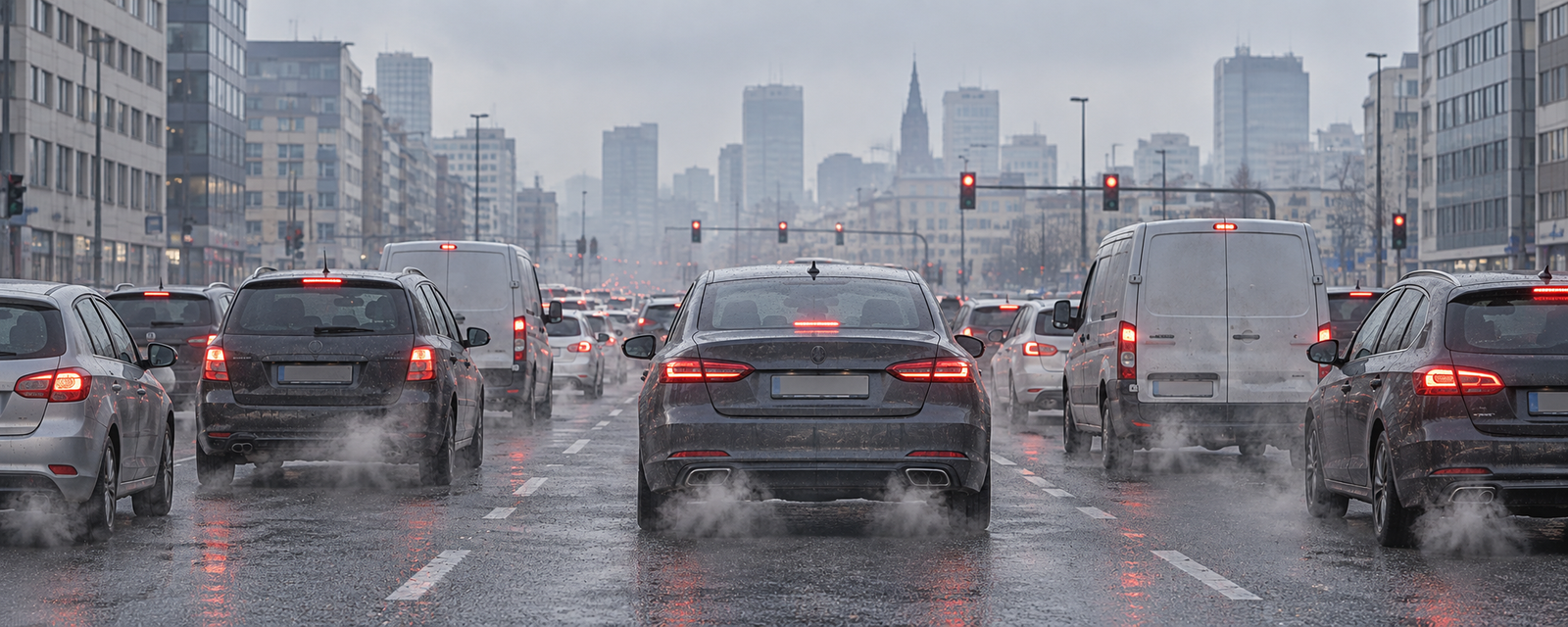
Smog and fine particlesTraffic and combustion particles
F7 + G4 set: ePM1 60% for supply air and ISO Coarse for extract air, 499 × 158 × 22 mm.
Particle images are illustrative. Vortice and Zehnder are examples of compatible units; the comparison concerns ZenAero filter classes.
When should you choose ePM10 or ePM1?
Pollen and seasonal dust
ePM10 can be a good choice when outdoor dust and pollen are your main concern and your unit uses this class.
Traffic and heating
For finer filtration of incoming air, choose a compatible ePM1 filter to reduce smaller particles associated with smog and combustion.
Air extracted from your home
Here, the filter mainly protects the unit from household dust. Depending on the model, the class may be ePM10 or ISO Coarse.
How do F7, M5 and G4 fit in?
Manuals often use the older labels: F7 for fine filtration, M5 for intermediate filtration and G4 for coarse particles. The products shown here declare ePM1 60% for F7, ePM10 60% for M5 and ISO Coarse for G4. There is no universal conversion between the old and new classifications; read the class on the product.
The right combination for your ventilation unit
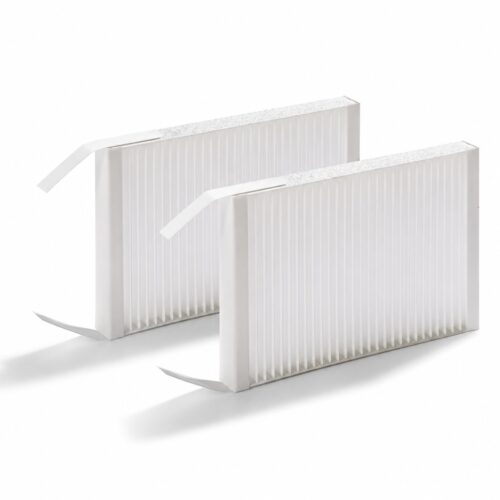
Some units use two filters of the same class. Others pair a fine supply-air filter with a different extract-air filter. Here are three examples.
Identify the unit Read the full model name on the unit label.
Compare all three dimensions Measure the frame, including its thickness.
Check the filter class Read the class for each side and the contents of the set.
Fit the filters in the right positions Follow the unit instructions and airflow arrows.
Keep your filtration working well
Check the filters every 4–6 months, and sooner during periods of heavy pollen, traffic or dust. Follow the unit’s filter alert and maintenance instructions. Replace disposable filters when loaded or damaged; clean filters help maintain good airflow.
Yes, to some extent. To choose a filter specifically classified for the finer PM1 fraction, look for ePM1. An ePM10 60% rating is different from ePM1 60%.
Will an ePM1 filter fit every ventilation unit?⌄
You need the correct format and a filter class suitable for your unit. Start with the full unit model and choose its compatible replacement.
Does F7 remove odours?⌄
F7 and ePM1 describe particle filtration. For odours and gases, consider a compatible combined filter with activated carbon.
Full model names and stated dimensions help you choose the correct replacement.
Clear filter classes
Read the individual product’s ISO class and choose the configuration specified for your unit.
Filtration and airflow
Filter media and construction matter alongside class: compare the set specifications.
Sets and help choosing
Compare the available packs. If unsure, identify the brand, model and dimensions before ordering.
Manage Consent
To provide the best experiences, we use technologies like cookies to store and/or access device information. Consenting to these technologies will allow us to process data such as browsing behavior or unique IDs on this site. Not consenting or withdrawing consent, may adversely affect certain features and functions.
Functional
Always active
The technical storage or access is strictly necessary for the legitimate purpose of enabling the use of a specific service explicitly requested by the subscriber or user, or for the sole purpose of carrying out the transmission of a communication over an electronic communications network.
Preferences
The technical storage or access is necessary for the legitimate purpose of storing preferences that are not requested by the subscriber or user.
Statistics
The technical storage or access that is used exclusively for statistical purposes.The technical storage or access that is used exclusively for anonymous statistical purposes. Without a subpoena, voluntary compliance on the part of your Internet Service Provider, or additional records from a third party, information stored or retrieved for this purpose alone cannot usually be used to identify you.
Marketing
The technical storage or access is required to create user profiles to send advertising, or to track the user on a website or across several websites for similar marketing purposes.