M5 filter explained without the filter-class jargon
An M5 filter is the middle ground between coarse G4 filtration and finer F7 filtration. In residential MVHR and heat-recovery systems, it can be a sensible choice when you want better control of pollen, dust and PM10-range particles without automatically moving to a finer F7 or ePM1 filter.
The key question is not whether M5 is “good” or “bad”, but whether the outdoor air around your home is mainly a PM10 problem or whether fine PM2.5 pollution from traffic, heating or smoke is the bigger concern.
✓
The short practical answer
Choose M5 if you are sensitive to pollen, outdoor PM10 pollution is elevated, and fine PM2.5 pollution is not the main problem where you live. Compared with G4, M5 provides much better protection against pollen and PM10-range particles that a coarse filter does not effectively capture. If there is no significant fine-particle pollution from solid-fuel heating, heavy road traffic or industrial emissions, M5 offers a strong balance between useful particle protection, low airflow resistance and practical service life.
What is an M5 filter?
M5 is a filter class from the older EN 779 system. It sat in the medium filtration range: finer than G4, but below F7. You will still see M5 in ventilation-unit manuals, replacement-filter catalogues and normal product searches.
The current ISO 16890 system classifies general-ventilation filters by particulate-matter efficiency, using groups such as ISO Coarse, ePM10, ePM2.5 and ePM1. That means an M5 label cannot be converted into one exact ISO percentage.
G4Legacy coarse filtration
M5Legacy medium filtration
F7Legacy fine filtration
ISO 16890Coarse, ePM10, ePM2.5, ePM1
M5 is not automatically ePM10 60%. Eurovent comparison data from 91 real filters shows that filters rated M5 under EN 779 overlapped across roughly 5–35% ePM1, 10–45% ePM2.5 and 40–70% ePM10. The exact ISO 16890 result belongs to the specific filter, not to the old M5 label alone.
40–70%Eurovent observed ePM10 range for legacy M5 filters
10–45%Eurovent observed ePM2.5 range
5–35%Eurovent observed ePM1 range
ePM10 60%Rating used on the ZenAero M5 products listed below
M5 is useful because it captures much more of the medium-size particle load than a coarse G4 filter while still sitting below fine F7 filtration. For a homeowner, that makes it most relevant to pollen, outdoor dust, mould spores and PM10-range pollution.
PollenUseful seasonal reduction of larger airborne pollen particles
Mould sporesCan reduce many larger airborne spores entering with outdoor air
Dust and sandOutdoor dust, road dust, soil and other larger particles
PM10 particlesA meaningful share when the specific filter carries an ePM10 rating
Illustrative photos: Soumalya Mandal, Sandy Millar, Devon Janse van Rensburg and Call Me Fred / Unsplash.
An M5 filter also catches insects, fibres and other larger debris. On the extract-air side it can help keep the heat exchanger and internal surfaces cleaner than a very coarse filter would.
What M5 is weak at: the finest PM2.5 and PM1 particles, smoke particles, gases and odours. It is not a disinfection filter and should not be presented as protection against bacteria or viruses. If odour or gaseous pollution is the complaint, particle class alone will not solve it; a compatible activated-carbon combination filter is the relevant option.
When is an M5 filter enough?
M5 makes the most sense when the outdoor environment is relatively clean and the main reasons for filtration are pollen, dust and occasional PM10 episodes rather than persistent fine-particle pollution.
Cleaner suburban or rural air
If local PM2.5 levels are usually low and there is no busy road or combustion source nearby, M5 can be a practical middle option for supply air where the unit allows it.
Seasonal pollen
You do not automatically need F7 just because pollen is a concern. M5 can provide useful pollen reduction, while the exact result still depends on the specific filter and pollen size.
Temporary PM10 dust episodes
Dry weather, field work, construction dust or wind-blown mineral dust can raise PM10. A tested ePM10 filter is directly relevant to this particle range.
When should you move up to F7 or ePM1?
If your local air-quality data regularly shows elevated PM2.5, M5 is no longer the strong choice for incoming air. Fine combustion particles are common around heavy traffic, dense urban areas, winter wood or solid-fuel heating and smoke events.
🚗
Busy trafficFine traffic-related particulate pollution can make F7 more appropriate
🔥
Heating seasonWood and solid-fuel combustion can raise PM2.5 substantially
🌫️
Smog or inversionsFine particles can remain trapped even away from a main road
🌲
Wildfire smokeSmoke is dominated by fine particles that call for finer filtration
Do not judge only by “city” or “countryside”. Check local PM2.5 and PM10 data. WHO notes that PM2.5 can penetrate deep into the lungs and enter the bloodstream, which is why persistent fine-particle pollution deserves more attention than larger dust alone. WHO: air-pollution health impacts.
Where does an M5 filter go in an MVHR unit?
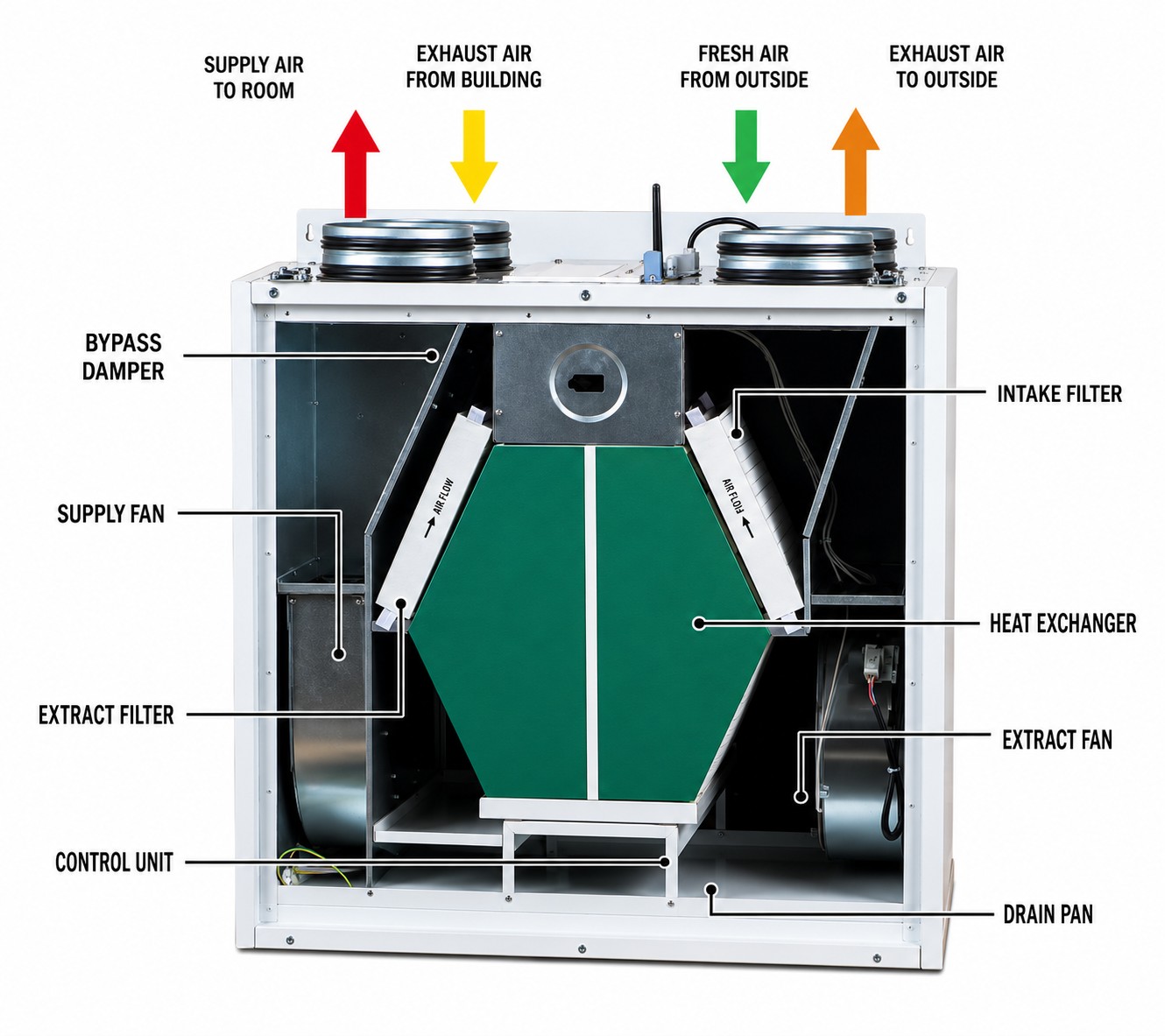
There is no one universal position. Some ventilation units use M5 on both air paths; others pair an F7 supply-air filter with an M5 extract-air filter. Always follow the model diagram and the airflow arrows on the filters.
1. M5 on both supply and extract air
Some Vortice units use an M5 + M5 arrangement. This gives medium particle filtration on the outdoor-air side while also protecting the unit from dust carried by extracted indoor air.
Other units use a mixed F7 + M5 set. The finer filter handles incoming outdoor air while M5 is used on the other side for better component protection than a coarse filter. This arrangement appears in products such as Aerauliqa QR280 and bluMartin freeAir 100.
Outdoor airFine pollution and pollen
→
F7 / ePM1Finer incoming-air filtration
→
Supply airTo bedrooms and living areas
Indoor extract airDust carried from rooms
→
M5 / ePM10Protects the unit and heat exchanger
→
Exhaust airAir leaves the building
The exact class on each side varies by model. Identify the outdoor-air and extract-air paths first, then install each filter in its specified position and airflow direction.
Do not swap positions simply because the filters fit. In a mixed F7 + M5 set, the finer F7 filter normally belongs on incoming outdoor air. If the classes are reversed, the home may receive less fine-particle protection while the extract side gets filtration it does not need.
M5 vs G4 vs F7: which filter should you choose?
The three classes solve different problems. The best filter is the one that matches the air quality around the home and the ventilation unit’s permitted resistance.
Practical comparison of G4, M5 and F7 ventilation filters
M5 is a real step up from G4 for incoming-air quality. It captures a substantially larger share of medium-size particles and is much more relevant when pollen and PM10 matter. The trade-off is higher airflow resistance than a typical coarse filter.
M5 vs F7
F7 provides much stronger filtration of fine PM2.5 and PM1 particles. That is useful around traffic, combustion and winter smog, but the finer medium often adds more resistance. If your air is generally clean and your main problem is pollen or PM10, M5 can be the more balanced choice.
Filter class does not define pressure drop by itself. Two filters with the same nominal class can have different resistance because pleat area, media, depth and construction differ.
Does M5 reduce airflow less than F7?
Often yes, but not as a universal rule. A less fine filter commonly creates less resistance than a denser fine-particle filter of similar size, which can make it easier for the ventilation unit to maintain airflow. Eurovent also notes that filter resistance directly affects ventilation energy use.
That does not mean every M5 automatically saves energy or lasts longer than every F7. The real pressure drop depends on the filter media, pleat area, dimensions, airflow and how quickly dirt loads the filter.
Lower resistance can help airflow
If the filter creates less pressure drop, the fan has less work to do to maintain the same airflow.
Surface area and filter media matter
A well-designed pleated F7 can sometimes outperform a poorly designed M5 on pressure drop. The filter material matters too. ZenAero uses modern EU-made low-resistance filter media in both its F7 and M5 filters to balance particle filtration with airflow performance. Compare the complete filter design and tested data where available, not the class label alone.
Dirty filters change everything
As dust accumulates, resistance rises. A clean higher-grade filter can perform better than a neglected lower-grade one.
How to choose and replace an M5 filter
Check the exact ventilation-unit model. Use the unit manual, old-filter label or model plate. Dimensions alone are not enough.
Confirm the class and position. If the set contains F7 + M5, note which filter belongs on the outdoor-air side before removing the old filters.
Install in the airflow direction. Follow the arrow on the filter frame or unit. A filter installed backwards can load unevenly and may create unnecessary resistance.
Inspect regularly rather than relying on the calendar alone. As a practical starting point, inspect every few months. Many residential systems are serviced around every six months, but dust, construction, pollen peaks or nearby traffic can shorten that substantially.
Signs the filter needs changing earlier
Airflow feels weaker
Rooms feel stuffy, especially in the morning, or the system no longer seems to move the same amount of air.
Noise increases
The fans may run harder as filter resistance rises. A change in normal system noise is worth checking.
The filter is visibly loaded
Heavy dust, darkened media or a unit filter warning are direct reasons to inspect and replace it.
Do not wash or vacuum disposable pleated M5 filters. Particles are held inside the depth of the media, not only on the surface. Vacuuming does not restore the original filtration performance and can damage the material. Remove a used filter with gloves, place it in a bag and dispose of it according to local household-waste rules unless the manufacturer specifies otherwise.
M5 filter sets for common ventilation units
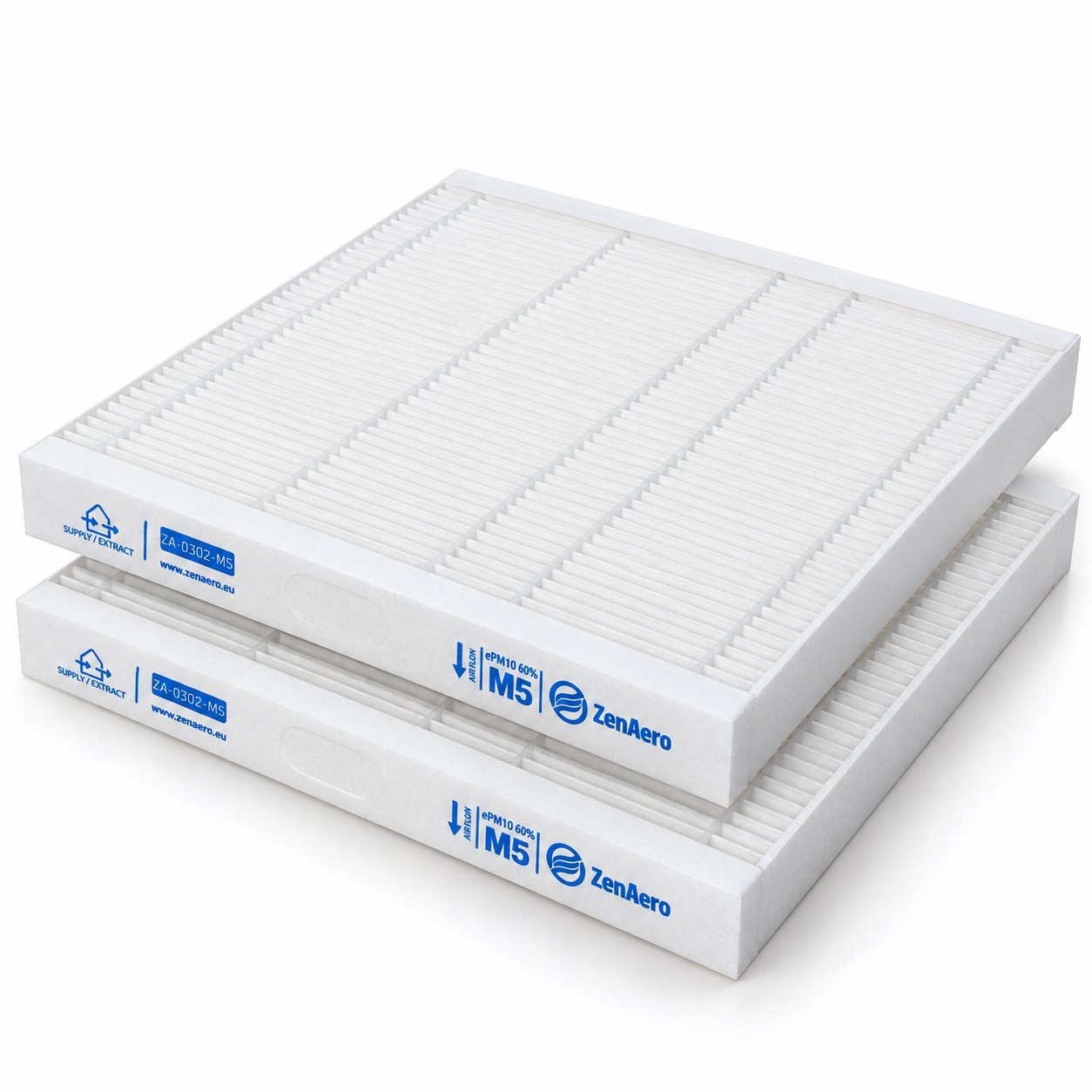
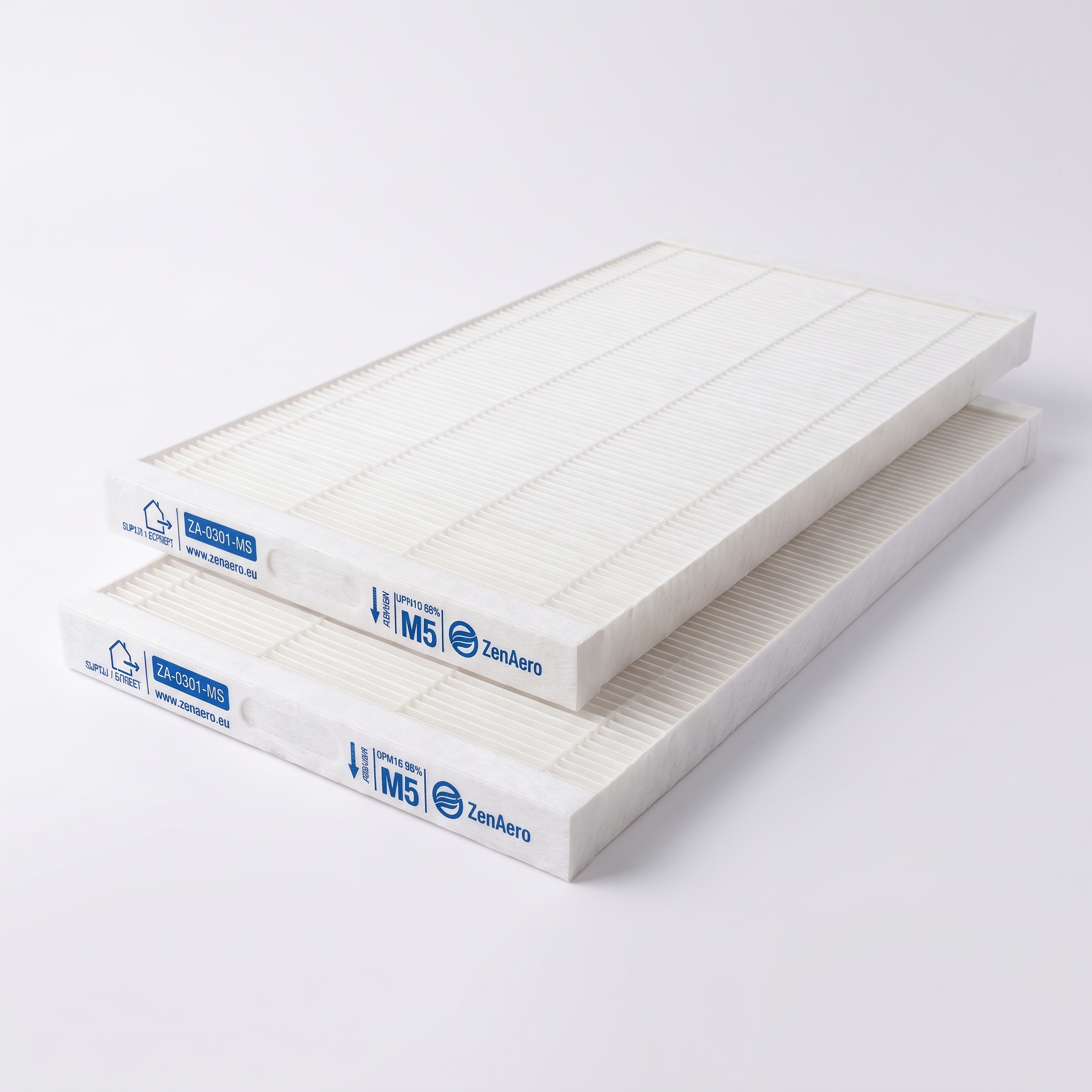
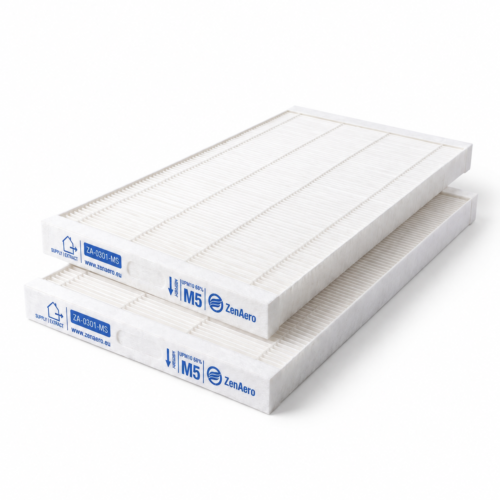
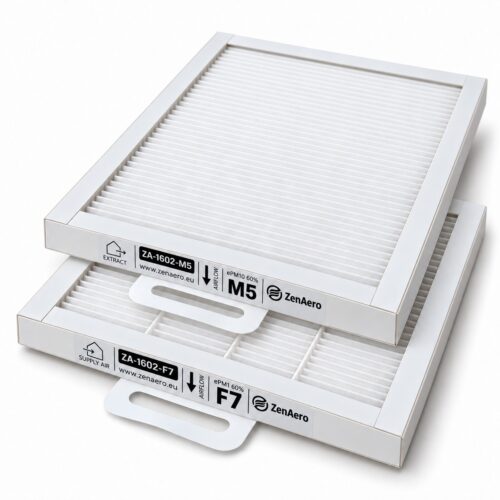
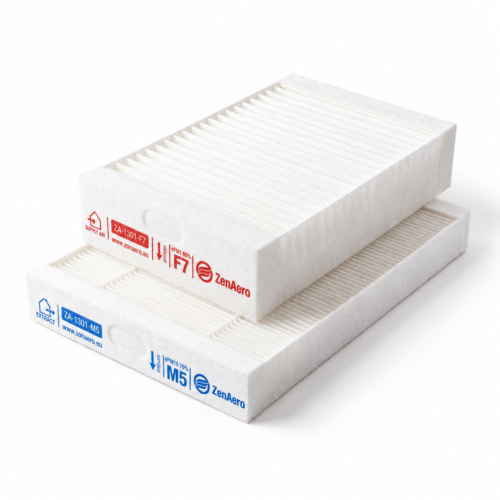
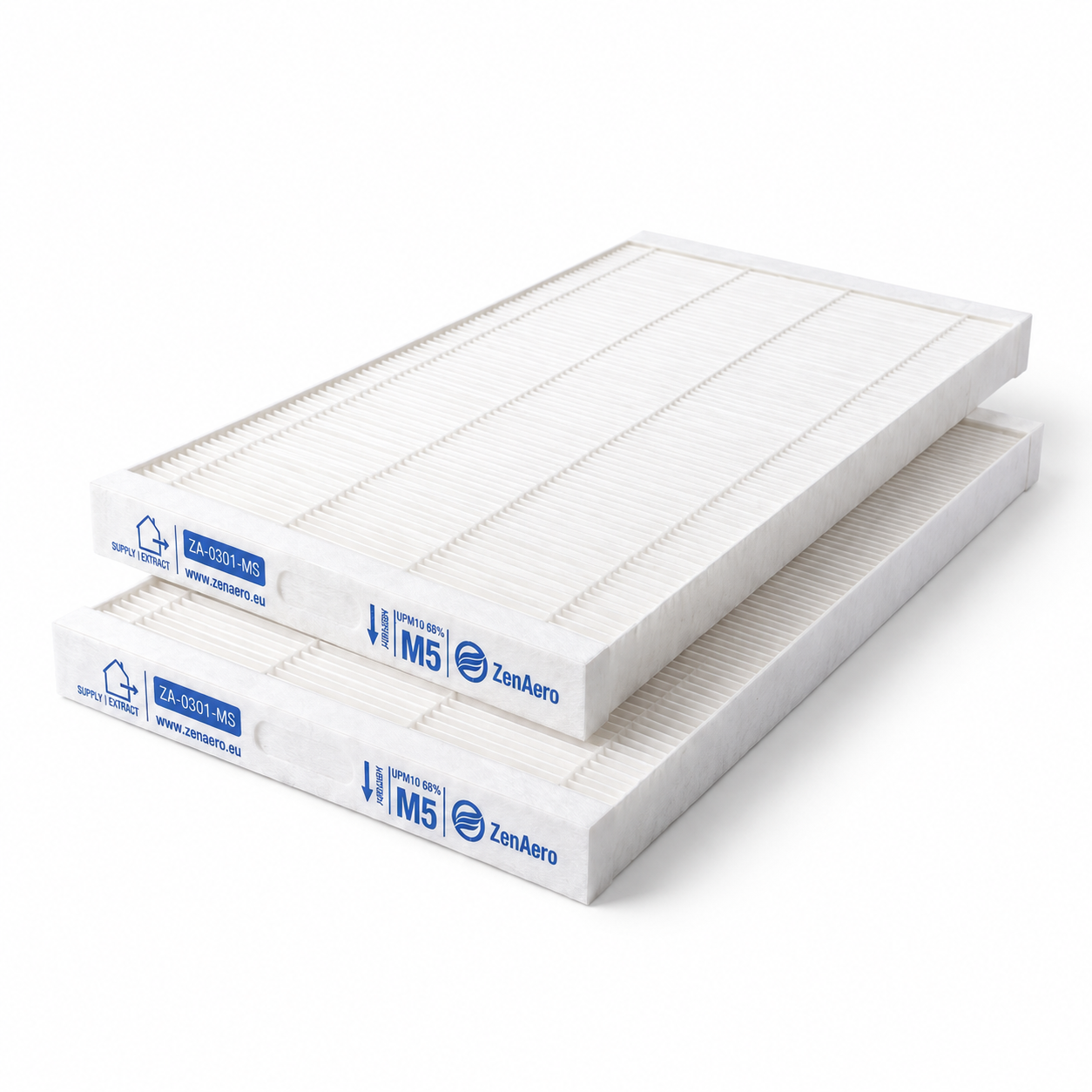
These ZenAero compatible products contain M5 / ePM10 60% filtration either as an M5 + M5 set or paired with an F7 supply-air filter. Choose by the exact ventilation-unit model and dimensions.
M5 is a medium-filtration class from the older EN 779 system. It sits between coarse G4 and fine F7 filtration.
Is M5 the same as ePM10 60%?⌄
No. There is no exact one-to-one conversion. Eurovent test data for legacy M5 filters spans roughly 40–70% ePM10. The ZenAero M5 products listed in this article are specified as ePM10 60%.
Does M5 remove pollen?⌄
It can provide useful pollen reduction because pollen particles are generally much larger than PM2.5. The M5 label itself does not define one universal pollen-capture percentage.
Is M5 better than G4?⌄
For particle filtration, yes: M5 captures substantially more medium-size dust and is more relevant to pollen and PM10. G4 still makes sense where the job is mainly coarse unit protection.
Is F7 better than M5?⌄
F7 is much stronger for fine PM2.5 and PM1 particles. That makes it the better option in polluted locations, but it commonly adds more airflow resistance than M5.
Is M5 enough in a city?⌄
Sometimes, but do not decide by the word “city”. Check local PM2.5 and PM10 data. If PM2.5 is regularly elevated because of traffic, heating or smog, use a compatible F7 or tested ePM1 option.
Does M5 remove smoke or exhaust smell?⌄
Not adequately. M5 is weak on the finest combustion particles and does not remove gases or odours. Finer particle filtration helps with smoke particles, while odour control requires activated carbon.
Can I vacuum or wash an M5 filter?⌄
Not if it is a disposable pleated filter. Vacuuming does not restore particles trapped inside the media and may damage the filter.
How often should an M5 filter be replaced?⌄
There is no universal interval. Inspect it every few months and follow the unit manufacturer’s guidance. Around six months is a common residential service rhythm, while dusty or polluted locations may require earlier replacement.
Which side of the MVHR unit takes M5?⌄
It depends on the model. Some units use M5 on both sides; others pair F7 on incoming air with M5 on extract air. Follow the unit diagram and airflow arrows.
To provide the best experiences, we use technologies like cookies to store and/or access device information. Consenting to these technologies will allow us to process data such as browsing behavior or unique IDs on this site. Not consenting or withdrawing consent, may adversely affect certain features and functions.
Functional
Always active
The technical storage or access is strictly necessary for the legitimate purpose of enabling the use of a specific service explicitly requested by the subscriber or user, or for the sole purpose of carrying out the transmission of a communication over an electronic communications network.
Preferences
The technical storage or access is necessary for the legitimate purpose of storing preferences that are not requested by the subscriber or user.
Statistics
The technical storage or access that is used exclusively for statistical purposes.The technical storage or access that is used exclusively for anonymous statistical purposes. Without a subpoena, voluntary compliance on the part of your Internet Service Provider, or additional records from a third party, information stored or retrieved for this purpose alone cannot usually be used to identify you.
Marketing
The technical storage or access is required to create user profiles to send advertising, or to track the user on a website or across several websites for similar marketing purposes.


 Pollen
 Mould spores
 Dust and sand
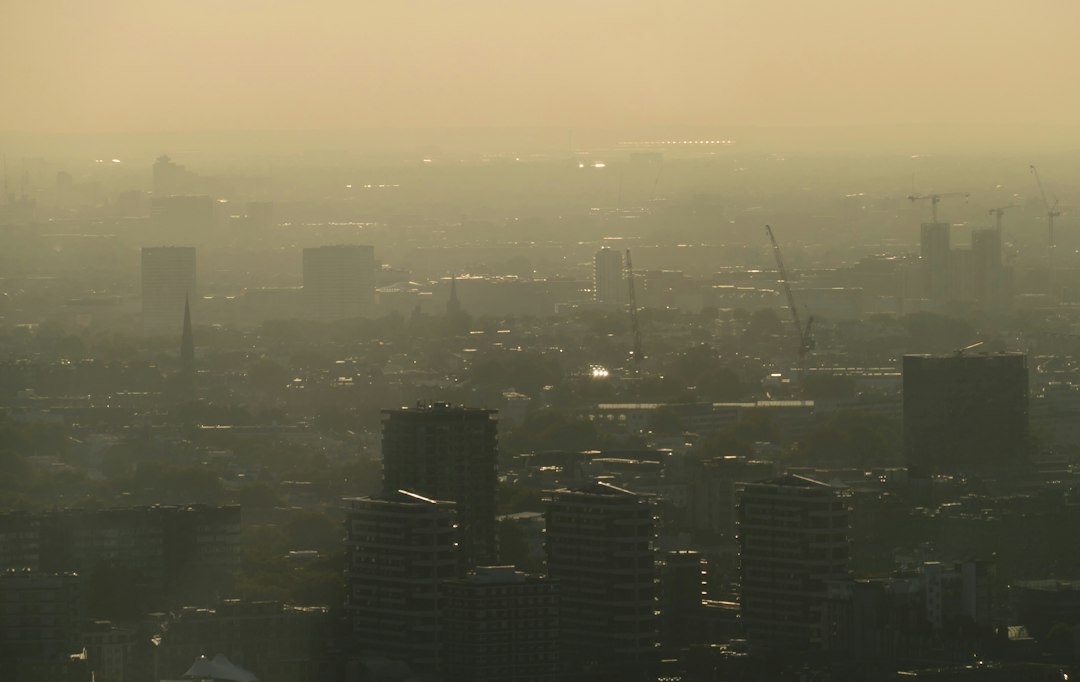 PM10 particles