To identify a replacement filter for an Alpac ventilation unit, start with the complete unit model, production period and code printed on the existing filter. The brand or commercial range alone is not enough. For Compact units made from June 2019, Alpac says that a Nuova Compact filter may be needed; confirm the code and dimensions rather than relying on the date alone.
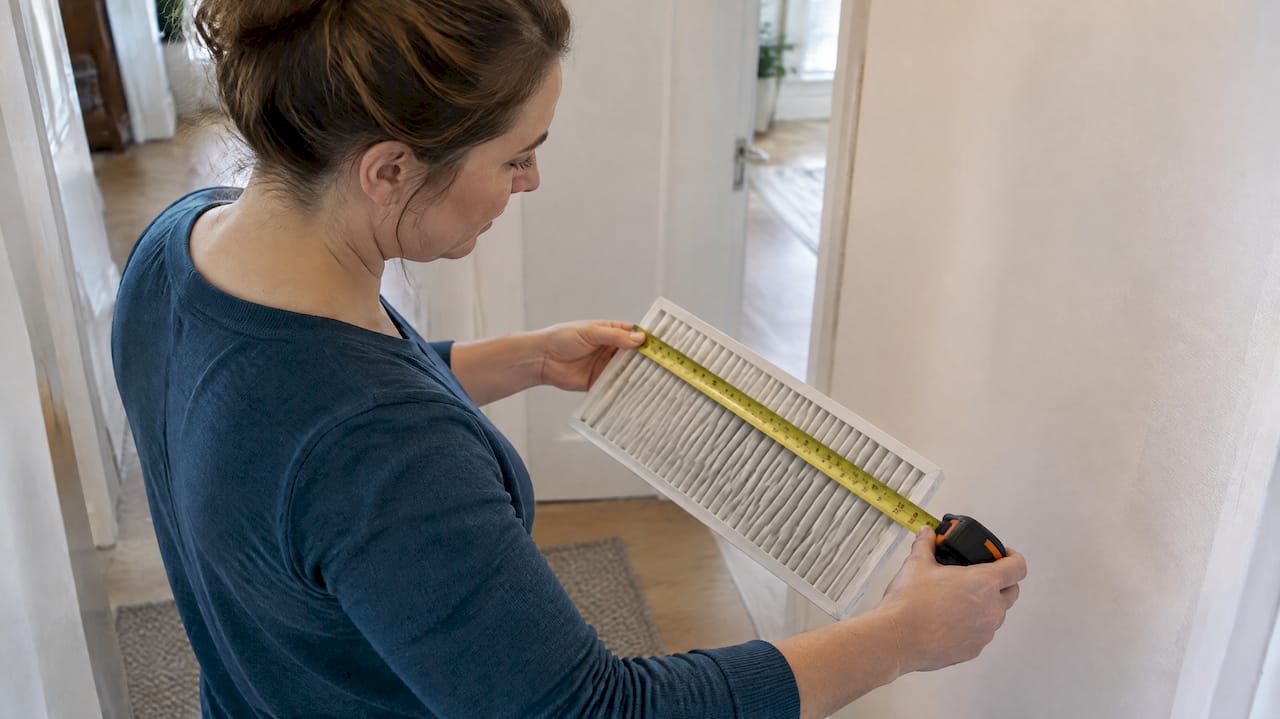
General illustration of filter measurement; it does not identify a verified Alpac/Helty replacement.
Start with the code: match the marking on the existing filter to the replacement specification. One example is 4VMC00000150.
Check the configuration: some units use two separate filters; others use one element with sections for both air streams.
Do not confuse dimensions: the 460 × 130 mm measurement in Alpac’s identification guide is for the COMPACT control panel, not the filter.
Follow the specific maintenance interval: Alpac’s general FAQ mentions at least annual replacement, while Helty recommends at least every six months for filter code 4VMC00000150, and more often in polluted areas.
If identification is uncertain: record the serial number and measurements and ask the manufacturer or service centre to confirm the replacement.
Why one Alpac filter does not fit every unit
Alpac offers ventilation solutions with different filter housings and layouts. A shared brand does not guarantee a shared filter size. Identify your unit before comparing replacements.
Concealed and wall-mounted units
The Alpac replacement-filter guide distinguishes concealed units, integrated into a window assembly or wall, from surface-mounted units with a removable front cover. The COMPACT control-panel dimensions of 460 × 130 mm are not filter dimensions. Measure the actual replacement element separately.
Compact before and after June 2019
Alpac notes that Compact units produced from June 2019 may require the Nuova Compact single filter, with a different code and size from the previous version. Units that look similar may therefore use different replacements. Check the manufacturing date on the identification plate or ask the manufacturer using the serial number. An installation date or invoice date is not necessarily the manufacturing date.
Alpac and Helty
Helty belongs to the Alpac group, which explains why the names often appear together. Helty’s FlowEASY is a wall-mounted single-room heat-recovery unit, while Flow40 is a concealed unit. A replacement listing may cover several Flow and Compact models, but versions and configurations still need checking against the installed filter.
Where to find the filter code and dimensions
Switch off the unit and wait for the fans to stop, following the unit’s instructions.
Open the cover or inspection hatch as described in the model’s manual.
Photograph the installed filter positions, including airflow arrows, before removal.
Read the code on the frame or label and note any declared filtration class.
Measure length, width and thickness in millimetres. Measure the frame rather than the pleated material.
Identify supply and extract positions. Establish whether the unit has two filters or a single element serving both air streams.
Compare all details with the replacement specification, including the number and type of elements in the pack.
If the marking is unreadable, record the complete model, serial number, dimensions and photographs. Measurements help identification, but do not by themselves prove compatibility.
Checks before ordering
Check
Where to find it
Why it matters
Unit type and full model
Identification plate and manual
Housings and configurations differ
Manufacturing date
Plate or manufacturer
Compact generations may need different filters
Filter code
Existing filter frame or label
The main reference for matching the replacement
Length × width × thickness
Direct measurement in mm
A poor fit can allow air to bypass the filter
Filtration classes
Filter label and specification
Check each air stream and version
Pack contents
Replacement specification
One element, a pair or a multipack are different quantities
Airflow direction
Arrows and manual
Fit each element in its intended orientation
When comparing suppliers, establish whether the stated price covers one filter, a complete set or several sets. Check current specifications and availability with that supplier; this guide makes no supply promise.
F7, G4, ePM2.5 65% and ISO Coarse
Alpac’s historical filter information describes fine filtration on incoming air and coarse filtration on extracted air. This describes the functions of the two streams; it does not mean every model has two separate removable elements or the same ISO classes.
For the specific replacement with code 4VMC00000150 printed on the filter, the Helty specification lists ePM2.5 65% + ISO Coarse 90% on the incoming side and ISO Coarse 70% on the extract side. These ratings must not be extended to every Alpac or Helty filter.
F7 and G4 belong to the older EN 779 classification. ISO 16890 uses ePM1, ePM2.5, ePM10 and ISO Coarse ratings with a different test method. There is no exact universal conversion from F7 to one ISO class. Read the declared rating of the specific replacement. See our ISO 16890 guide.
A finer filter can capture a larger proportion of the relevant particle fraction, but pressure drop also depends on material, area, construction, airflow and loading. Class alone cannot establish airflow resistance. Use the filtration specified for the unit and position unless the manufacturer gives other instructions. Our F7 versus G4 guide explains the general distinction.
Original or compatible replacement: what changes?
An original filter is made or supplied by the equipment manufacturer. A compatible replacement comes from another manufacturer and must have the dimensions and performance suitable for the intended housing. It is not an original part and should not be described as one.
Declared codes and models: the specification should identify the precise applications.
Dimensions: compare all three measurements, including thickness.
Filtration and configuration: check the ISO 16890 declaration for each stream or element and the set contents.
If essential data is missing, ask the supplier before ordering. A similar shape or the same nominal class does not establish fit, sealing or performance.
When to replace Alpac and Helty filters
The Alpac FAQ says to replace filters when the unit signals replacement and gives general advice of at least once a year. The Helty listing for 4VMC00000150 recommends at least every six months, more often in polluted areas. Follow the model manual, replacement instructions and the shorter applicable interval; the general annual advice does not override a specific six-month recommendation.
A warning is a reminder: some units use operating time rather than a direct measurement of clogging. Check how your model works and inspect more often in dusty conditions.
Cleaning is not replacement: do not wash the media or use compressed air unless the instructions for that specific filter explicitly permit it. Resetting the warning does not restore a used filter.
After replacement, reset the indicator using the procedure in the manual. Instructions differ by model. Our filter replacement interval guide provides general background.
Replacing filters without common mistakes
Orientation: follow the arrows and manual. Use the photograph taken before removal as a reference.
Supply and extract: keep separate filters in their specified positions. For a single element, preserve the orientation of the entire assembly.
Sealing: the filter should sit without folds, crushing or gaps around the edges. If fitting requires force, check the format.
Remove loose dust from the accessible housing as allowed by the manual. Deeper cleaning of the heat exchanger or internal components may require authorised service. Our MVHR and AHU filter replacement guide is a general outline, not a substitute for the unit’s instructions.
For installers, maintenance teams and property managers
A building can contain similar-looking units installed or produced at different times. Keep a record for each apartment or unit:
full model, serial number and manufacturing and installation dates where known;
filter codes, dimensions, stream positions and declared ISO classes;
last replacement date and the applicable maintenance interval;
conditions such as traffic, building work or other sources of dust.
This turns replacement sourcing into a check of specific codes and reduces the risk of mixing Compact generations.
Our approach
Verifiable identification comes first: complete unit model, filter code, dimensions and air-stream configuration. A similar format does not prove compatibility. A combined element also needs the correct filter sections and sealing.
If you cannot identify the replacement
Collect photographs of the unit plate and old filter, the code, serial number and measurements. Ask the manufacturer or an authorised service centre for confirmation. Do not assume that a custom-sized filter is suitable: structure, stream sections, sealing and pressure drop also need verification for that unit.
Frequently asked questions
Does an old Compact filter fit Nuova Compact?
Do not assume interchangeability. Alpac says units produced from June 2019 may need Nuova Compact. Match the code and measurements; a range name or date alone does not guarantee fit.
Can I wash the filter?
Only if the instructions for that specific filter permit it. Where replacement is required, washing or blowing the media is not an alternative.
How often should I change it?
Use the unit and replacement instructions. Alpac’s general FAQ mentions at least annual replacement; Helty recommends at least six-monthly replacement for 4VMC00000150. Observe the applicable shorter interval and warning indicator.
Is F7 the same as ePM2.5 65%?
Not automatically. EN 779 and ISO 16890 use different methods. Read the specific filter’s declaration.
What if the old code cannot be read?
Record the full model, serial number and three dimensions and ask the manufacturer or service centre to identify the correct replacement.
All trademarks belong to their respective owners and are used to identify equipment and replacement compatibility. A third-party compatible replacement is not an original part. Always verify the full model, code, dimensions and specifications.
Manage Consent
To provide the best experiences, we use technologies like cookies to store and/or access device information. Consenting to these technologies will allow us to process data such as browsing behavior or unique IDs on this site. Not consenting or withdrawing consent, may adversely affect certain features and functions.
Functional
Always active
The technical storage or access is strictly necessary for the legitimate purpose of enabling the use of a specific service explicitly requested by the subscriber or user, or for the sole purpose of carrying out the transmission of a communication over an electronic communications network.
Preferences
The technical storage or access is necessary for the legitimate purpose of storing preferences that are not requested by the subscriber or user.
Statistics
The technical storage or access that is used exclusively for statistical purposes.The technical storage or access that is used exclusively for anonymous statistical purposes. Without a subpoena, voluntary compliance on the part of your Internet Service Provider, or additional records from a third party, information stored or retrieved for this purpose alone cannot usually be used to identify you.
Marketing
The technical storage or access is required to create user profiles to send advertising, or to track the user on a website or across several websites for similar marketing purposes.