ISO 16890 is the international system used to classify general-ventilation air filters according to their performance against particulate matter. Instead of relying only on the older EN 779 labels such as G4, M5 and F7, it reports performance relevant to PM1, PM2.5 and PM10. When choosing a replacement filter for an MVHR or HRV unit, however, the filter’s fit and pressure drop are just as important as its efficiency class.
In brief: ISO ePM1, ePM2.5 and ePM10 refer to particulate-matter efficiency; ISO Coarse describes filters for coarser dust. There is no universal exact conversion between EN 779 classes and ISO 16890. Always check the manufacturer’s requirements and the tested specification of the actual replacement product.
What does the ISO 16890 series cover?
ISO 16890 has four parts. Part 1 sets out the classification system, Part 2 covers fractional efficiency and airflow resistance measurements, Part 3 addresses gravimetric efficiency and dust-loading resistance, and Part 4 describes conditioning to reduce electrostatic charge before certain measurements. The standard concerns filter elements for general ventilation, not a promise that any filter medium will perform identically at any airflow or in every residential ventilation unit.
What do ePM1, ePM2.5 and ePM10 mean?
The ePMx indicators estimate a filter’s mass-based efficiency for particle-size fractions up to the respective nominal diameters. For example, a filter classified ISO ePM1 60% is rated at the indicated efficiency for the PM1 fraction under the test standard’s specified conditions. It does not guarantee that precisely 60% of all real-life pollutants in a particular home will disappear.
ISO ePM1: relevant to fine airborne particulate matter, including fractions generated by combustion and traffic.
ISO ePM2.5: addresses particulate matter up to 2.5 micrometres.
ISO ePM10: covers a wider size fraction, including larger airborne dust particles.
ISO Coarse: used for filters not meeting the threshold for an ePM class; classification is based on coarse test-dust arrestance.
These are particle-filtration classifications, not measurements of gas or odour removal. For official methodology, consult ISO and relevant Eurovent guidance.
Can G4, M5 or F7 be converted to an ISO 16890 class?
Not accurately in every case. The old EN 779 system and ISO 16890 use different measurements and classification criteria. Comparison tables can give an approximate orientation, but they are not proof that two particular products have identical performance. Look for the actual ISO rating on the replacement filter’s technical documentation.
How do you choose the right filtration class for MVHR?
Check the make, model and exact version of the ventilation unit.
Identify the relevant airflow path. The filter on the route from outside air to rooms has a different task from the filter on the extract-air route.
Follow the unit manufacturer’s approved filter specification and installation instructions.
Check the replacement element’s actual dimensions, frame, seals and stated pressure drop at the relevant airflow.
Consider outdoor particulate pollution and the expected servicing interval without exceeding the unit’s operating limits.
Fine filters can have different pressure drops even within one efficiency class. Filter design, effective surface area, airflow rate and accumulated dust influence resistance. There is no universal replacement interval inferred solely from the class name.
Check the unit before ordering
Record the equipment nameplate, filter reference, length, width and depth in millimetres, airflow arrow and any seals or tabs. Do not swap the outside-air and extract-air positions. Our guide to choosing compatible MVHR filters explains the checks in more detail.
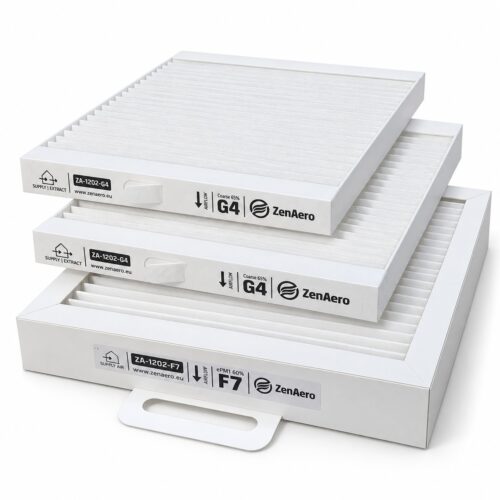
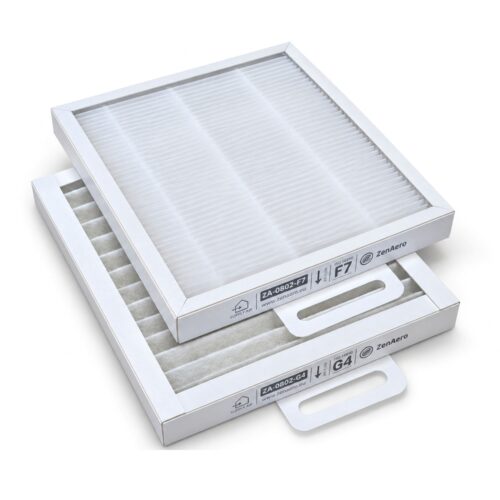
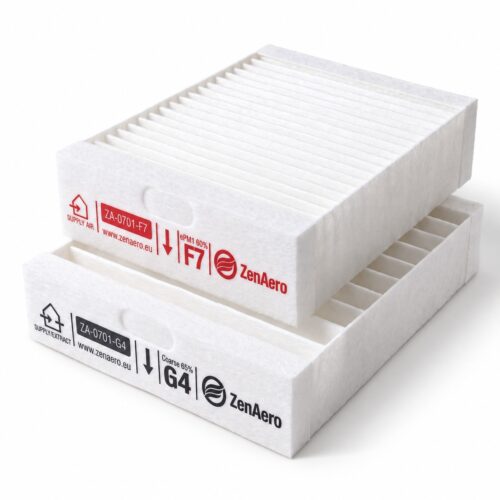
Examples of compatible filters in the ZenAero catalogue
The following examples are model-specific replacement products with filtration details in their listings. Their exact suitability must be confirmed for your unit. ZenAero compatible filters are not original parts made by the ventilation unit manufacturer.
Does ePM1 60% mean the filter removes 60% of every harmful particle?
No. It is a classification based on the relevant PM1 particle-mass fraction under standardised testing. Actual indoor exposure depends on many factors, including airflow, filtration bypass and indoor sources.
Is F7 exactly the same as ISO ePM1?
No. An old F7 designation alone cannot establish a precise ISO ePM1 percentage.
Should I replace a G4 filter with an F7 filter?
Not without checking the filter’s position and the unit manufacturer’s permitted specification, fitting requirements and airflow resistance.
Third-party trademarks identify compatible ventilation units only; they do not indicate manufacturer endorsement.
Manage Consent
To provide the best experiences, we use technologies like cookies to store and/or access device information. Consenting to these technologies will allow us to process data such as browsing behavior or unique IDs on this site. Not consenting or withdrawing consent, may adversely affect certain features and functions.
Functional
Always active
The technical storage or access is strictly necessary for the legitimate purpose of enabling the use of a specific service explicitly requested by the subscriber or user, or for the sole purpose of carrying out the transmission of a communication over an electronic communications network.
Preferences
The technical storage or access is necessary for the legitimate purpose of storing preferences that are not requested by the subscriber or user.
Statistics
The technical storage or access that is used exclusively for statistical purposes.The technical storage or access that is used exclusively for anonymous statistical purposes. Without a subpoena, voluntary compliance on the part of your Internet Service Provider, or additional records from a third party, information stored or retrieved for this purpose alone cannot usually be used to identify you.
Marketing
The technical storage or access is required to create user profiles to send advertising, or to track the user on a website or across several websites for similar marketing purposes.