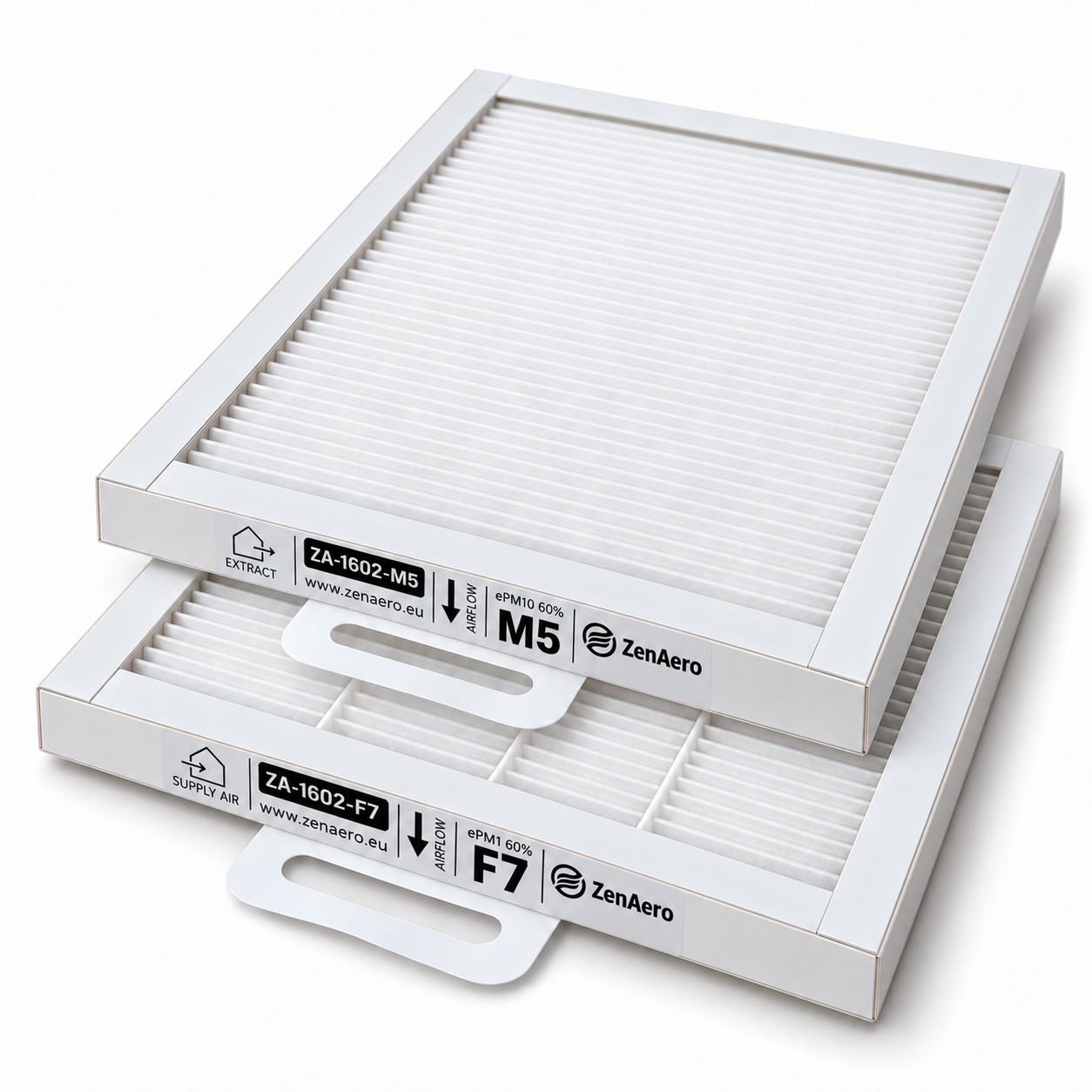
ISO 16890 classifies general-ventilation air filters by their efficiency against atmospheric particulate-matter fractions: PM1, PM2.5 and PM10. Its European adoption, EN ISO 16890, replaced EN 779 and its familiar G4, M5 and F7 labels. For homeowners, building managers and installers, reading a marking such as “ISO ePM10 60%” has a practical purpose: selecting the correct replacement and comparing products on a consistent basis.
At a glance
- The four groups are ISO ePM1, ISO ePM2.5, ISO ePM10 and ISO Coarse, followed by a declared percentage.
- Part 1 sets the classification system; the other three parts define test methods.
- Testing also includes electrostatic discharge to assess minimum fractional efficiency.
- G4, M5 and F7 have no exact, universal ISO equivalents: use the declaration for the individual product.
- Start with the unit’s make, model and dimensions, then choose a manufacturer-approved class.
Real examples of filters and ISO classes
Compare the declared classes and open each set to check the exact model, dimensions and pack options.
Aerauliqa QR280A / QR280E / QR280M / QR280PH – Compatible Filter Set ePM1 60% + ePM10 60% (F7 + M5), 250 × 183 × 21 mm
Choose the set →
Zehnder ComfoAir Q 350 / 450 / 600 – Compatible Filter Set ePM1 + ISO Coarse (F7 + G4), 499 × 158 × 22 mm
Choose the set →

Vortice HRI 200 FLAT / HRI 200 PHANTOM – Compatible Filter Set ePM10 60% + ePM10 60% (M5 + M5), 227 × 212 × 24 mm
Choose the set →
Contents
What ISO 16890 is and what it replaced
ISO 16890 is the international standard for particulate air filters used in general ventilation, including air-handling units, HVAC systems and residential heat-recovery ventilation. Part 1 establishes an efficiency classification based on particulate matter and sets out general requirements and test procedures. The Italian adoption is UNI EN ISO 16890-1:2017; national publication references can differ.
The transition from EN 779 was gradual. Italian training material from AICARR describes June 2018 as the completion of its replacement by EN ISO 16890. Manufacturers now declare performance with the newer groups, while catalogues often retain legacy labels for familiarity.
The central difference is what is measured. EN 779 included synthetic-dust loading/arrestance tests and fine-filter efficiency assessment at a reference particle size. ISO 16890 assesses efficiency across a range of particle sizes and relates it to PM1, PM2.5 and PM10 fractions used in outdoor-air-quality assessment. These different methods prevent a precise one-to-one conversion.
As checked on 23 October 2026, ISO lists the second edition of Part 1 as under publication, to replace ISO 16890-1:2016. For replacement selection, continue to check the actual declaration and technical information supplied with the individual product.
The four parts of the standard
ISO 16890 is a series of four documents, each with a separate purpose.
| Part | ISO edition | Scope |
|---|
| ISO 16890-1 | 2016; replacement edition under publication | Technical specifications, requirements and the ePM classification system |
| ISO 16890-2 | 2022 | Fractional efficiency and airflow resistance |
| ISO 16890-3 | 2024 | Gravimetric efficiency and airflow resistance against captured test-dust mass |
| ISO 16890-4 | 2022 | Conditioning method for determining minimum fractional efficiency |
The Part 1 laboratory method specifies airflow between 900 and 5,400 m³/h for a test rig with a nominal 610 × 610 mm face area. Compact domestic filters operate at different sizes and flows. A declared class describes performance under the specified test conditions; it cannot by itself predict the efficiency or service life of a filter in your particular unit.
The four groups: ISO ePM1, ePM2.5, ePM10 and ISO Coarse
Classification is based on efficiency for the relevant particulate fraction. For the finer groups, minimum efficiency after electrostatic discharge also matters.
| Group | Reference | Entry requirement | Typical ventilation role |
|---|
| ISO Coarse | Coarse dust | ePM10 below 50%; gravimetric arrestance is declared | Prefiltration and exchanger protection |
| ISO ePM10 | Particles up to 10 µm | ePM10 at least 50% | Extract and, in some units, supply air |
| ISO ePM2.5 | Particles up to 2.5 µm | Minimum ePM2.5 efficiency at least 50% | Supply air where specified |
| ISO ePM1 | Particles up to 1 µm | Minimum ePM1 efficiency at least 50% | Fine incoming-air filtration |
The percentage after the group is the declared efficiency, rounded down in 5-percentage-point steps. For example, a measured ePM10 value of 63% is declared as ISO ePM10 60%. A filter can have values for several fractions; the classification identifies the finest group for which it meets the requirements.
ISO Coarse uses a different metric: gravimetric arrestance, the mass proportion of test dust captured under the Part 3 method, rather than an ePM fraction efficiency.
Reading a product marking
The compatible Vortice HRI 200 FLAT / HRI 200 PHANTOM set is a real example. Its description contains three separate pieces of information:
- ePM10 60% + ePM10 60%: two filters, each declaring ISO ePM10 60%.
- M5 + M5: legacy EN 779 labels retained as a reference.
- 227 × 212 × 24 mm: the dimensions to compare with the installed filters.
Our guide to ePM1, ePM2.5 and ePM10 explains the individual markings with more examples.
Why electrostatic discharge changes the results
Many synthetic filter media carry an electrostatic charge that assists fine-particle capture, especially when new. Use, humidity and contamination can affect this charge and the resulting performance.
Part 4 defines conditioning that discharges the medium to determine minimum fractional efficiency. The filter is assessed before and after conditioning. For ePM1 and ePM2.5 groups, the respective minimum efficiency must also meet the 50% threshold.
These classes therefore account for performance after removal of the electrostatic contribution under the test method. Comparing filters only by a legacy EN 779 label can miss this distinction.
G4, M5, F7 and ISO 16890: why there is no exact conversion
“My old filter was F7—which ISO class should I buy?” is a common question. There is no official universal one-to-one conversion because the standards evaluate performance differently. EN 779’s reference-particle efficiency and dust-loading methods differ from the ISO ePM assessment and conditioning.
Catalogues often associate G4 with ISO Coarse, M5 with ePM10, and F7 with ePM2.5 or ePM1. These are indicative patterns, not equivalences. Two F7-labelled filters may declare different ISO values depending on their media and construction. Check the actual class and percentage.
| If you know… | What to do |
|---|
| Only the old G4, M5 or F7 class | Use it as a starting point, then read the replacement’s ISO declaration |
| The installed filter’s ISO class | Look for the same class or the one specified by the unit manufacturer |
| Neither class | Start with the make, exact model and filter configuration in the manual |
See also our M5 filter guide and comparison with G4 and F7.
How to choose a ventilation filter using ISO 16890
- Identify the unit. Read its exact make and model from the label or manual. Model variants can use different filters.
- Check the dimensions. Measure length, width and thickness in millimetres and compare the installed filter with the documentation.
- Check the configuration. Establish how many supply/extract filters are required and which class goes in each position.
- Choose an approved ISO class. Finer filtration can increase resistance; media and construction also affect pressure drop. Stay within the manufacturer’s allowed options.
- Confirm product compatibility. If your precise model is not listed, request a check before ordering.
The housing is often overlooked. A high-class filter in the wrong size or poorly installed can let air bypass its edges. That air is not filtered, regardless of the printed class. If no standard replacement matches, consider custom-made ventilation filters.
Building managers and maintenance contractors should record the make, model, dimensions and ISO class for each filter position. This makes repeat orders easier. Our compatible-filter guide explains how to use those details.
When to replace the filter: class is not enough
ISO 16890 classifies filtration efficiency; it does not prescribe a universal replacement interval. Service life depends on the unit, filter class, airflow, outdoor conditions and season. Urban heating-season pollution can load a filter differently from a rural summer setting.
Use the unit manufacturer’s instructions and its filter reminder. The European Ecodesign guidance for ventilation units discusses filter-change warning requirements under the applicable regulations. Some reminders use operating hours; others depend on pressure difference, which rises as the filter loads.
Replace the filter when instructed, or earlier if inspection reveals heavy loading or damage. Many domestic filters are disposable, so do not wash them unless the manufacturer expressly permits it. See when to replace ventilation filters.
Our approach
We help homeowners, installers and building managers choose replacement filters, and frequently see the same mistake: starting with class instead of the unit. ISO 16890 is useful for comparison, but even an ePM1 filter is unsuitable if its dimensions are wrong.
ZenAero product pages state compatible models, dimensions, pack contents and the declared ISO class. We may include a familiar EN 779 label as a reference, never as an exact conversion. Our products are compatible replacements, not original parts from the unit manufacturer. If you are unsure between classes, use the manufacturer’s specified configuration and request a compatibility check.
Find the filter for your ventilation unit
Our ventilation-filter catalogue is organised by brand, including Zehnder, Vortice, Aerauliqa and Brink where available. Read the class, size and number of filters on each current product page. Prices and stock can change. If your model is missing, contact us with its make, model and filter dimensions.
Frequently asked questions
How does ISO 16890 classification work?
The filter is tested over several particle sizes before and after conditioning. It qualifies for the finest group whose requirements it meets: ePM1, ePM2.5 or ePM10. Below 50% ePM10 it falls within ISO Coarse. Declared ePM efficiency is rounded down in 5-point steps.
Does F7 mean ISO ePM1?
Not necessarily. Many F7-labelled filters declare ePM1 or ePM2.5, but there is no exact universal conversion. Read the specific product’s declaration.
Which classes are common in domestic ventilation?
ISO Coarse and ePM10 are common on extract air; ePM10, ePM2.5 or ePM1 can be used on incoming air depending on the unit. Follow its manufacturer’s arrangement.
Can I install a higher-class filter?
Only if it is suitable for the unit. A finer filter may increase resistance beyond the permitted limit. Check the approved classes and ask the installer if unsure.
Sources