What Is a Ventilation Unit? Components, Types and How It Works
A practical guide to modern residential ventilation units. Learn how heat recovery ventilation works, what components are inside a ventilation unit, the differences between centralized and decentralized systems, and why ventilation units vary in price and performance.
A ventilation unit is an air treatment device that combines one or more fans with additional components such as filters, heat exchangers, sensors and controls. Its purpose is to supply fresh air, remove stale indoor air and help maintain healthy indoor air quality.
Today, when people talk about ventilation units in residential buildings, they usually mean heat recovery ventilation systems, also known as MVHR or HRV units. These systems continuously exchange indoor and outdoor air while recovering a significant part of the heat that would otherwise be lost through ventilation.
In more than 15 years of working with ventilation systems, I have noticed two common opinions. Some people initially see a ventilation unit as an unnecessary cost required by building regulations, but change their mind after living in a well-insulated home for a year. Others believe that all ventilation units are basically the same. In reality, internal components, engineering, control systems and testing make a major difference.
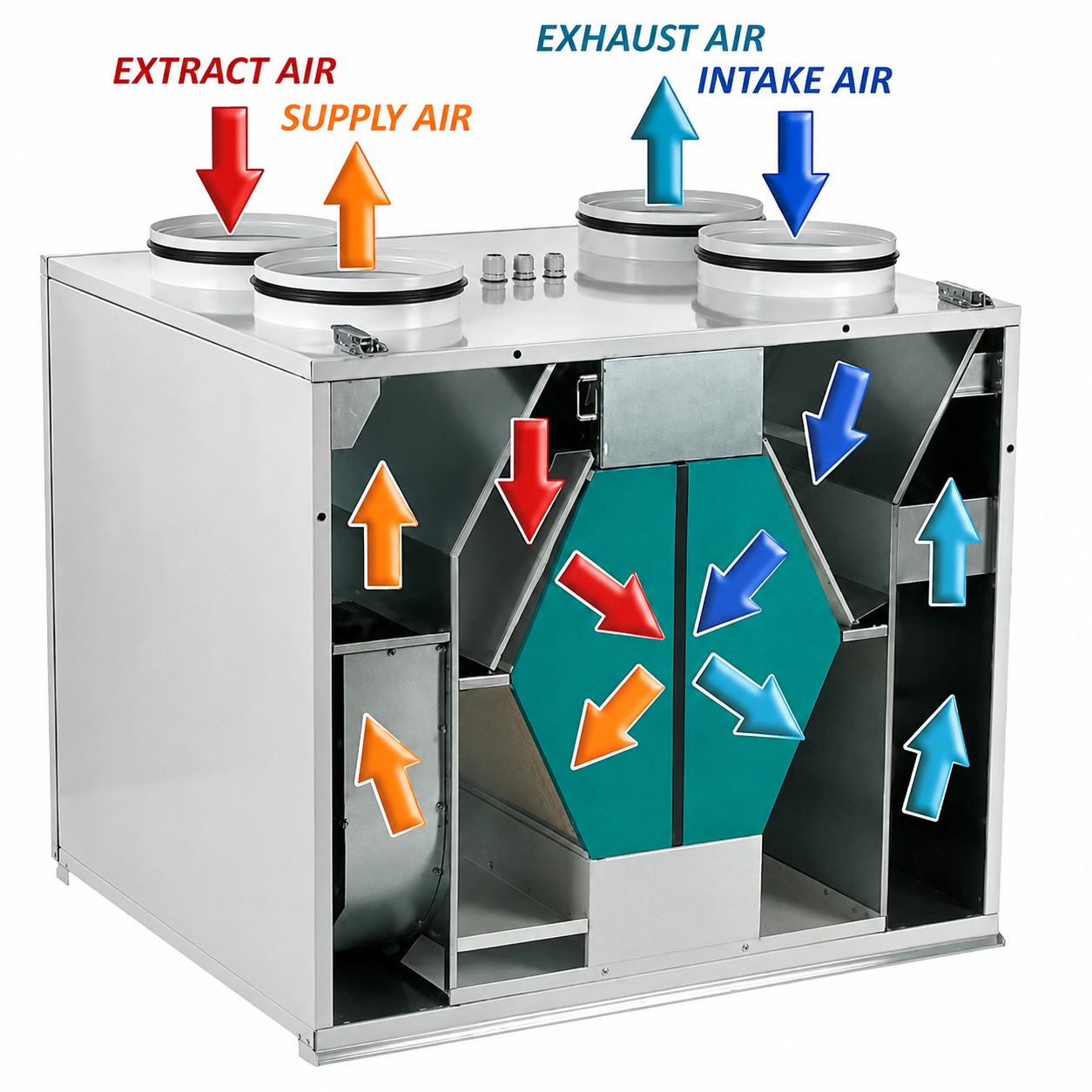
Basic operating principle of a heat recovery ventilation unit.
Ventilation Units: Then and Now
Historically, a ventilation unit could be as simple as a wall-mounted extract fan or a supply fan with a basic filter. These simple units still exist and are used in many commercial, industrial and special-purpose applications.
Modern residential ventilation systems are more advanced. Most units installed in new homes are dual-flow heat recovery ventilation units. They supply fresh outdoor air and extract polluted indoor air at the same time.
In simple terms: a modern residential ventilation unit is no longer just a fan. It is a controlled air treatment device that moves air, filters it, recovers heat and protects indoor comfort.
Main Types of Ventilation Units
Supply air units
Deliver fresh outdoor air into a building. Air extraction is handled separately.
Extract air units
Remove stale or humid indoor air from bathrooms, kitchens or utility rooms.
Dual-flow units
Supply fresh air and extract stale air at the same time. This is the standard solution for modern HRV/MVHR systems.
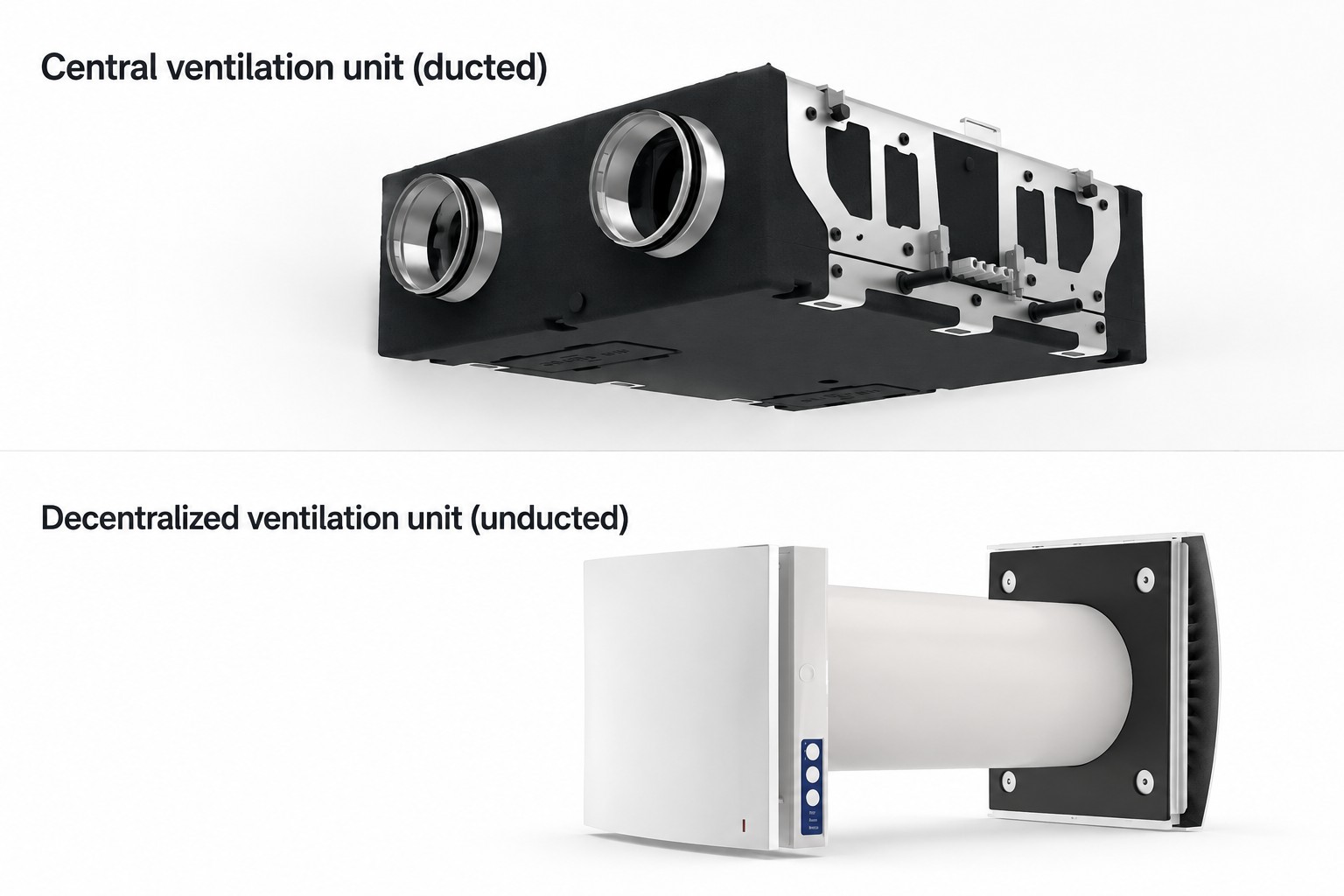
Centralized and decentralized ventilation systems.
Centralized and Decentralized Units
A centralized ventilation unit serves the whole building or apartment through air ducts. If you are looking for the best indoor climate in a new home, a central unit usually makes the most sense. It can deliver air to all rooms, including rooms without external walls, provide better filtration and usually achieve lower overall noise levels.
Decentralized units serve one room or a small zone. They are often used in older buildings where there is no space for a central unit or air ducts. If installing ducts would require a full renovation, decentralized ventilation can be an economically reasonable solution.
What Components Does a Modern Ventilation Unit Have?
Most residential ventilation units contain similar core components. The difference is often not the components themselves, but how well they are selected, integrated, controlled and tested.
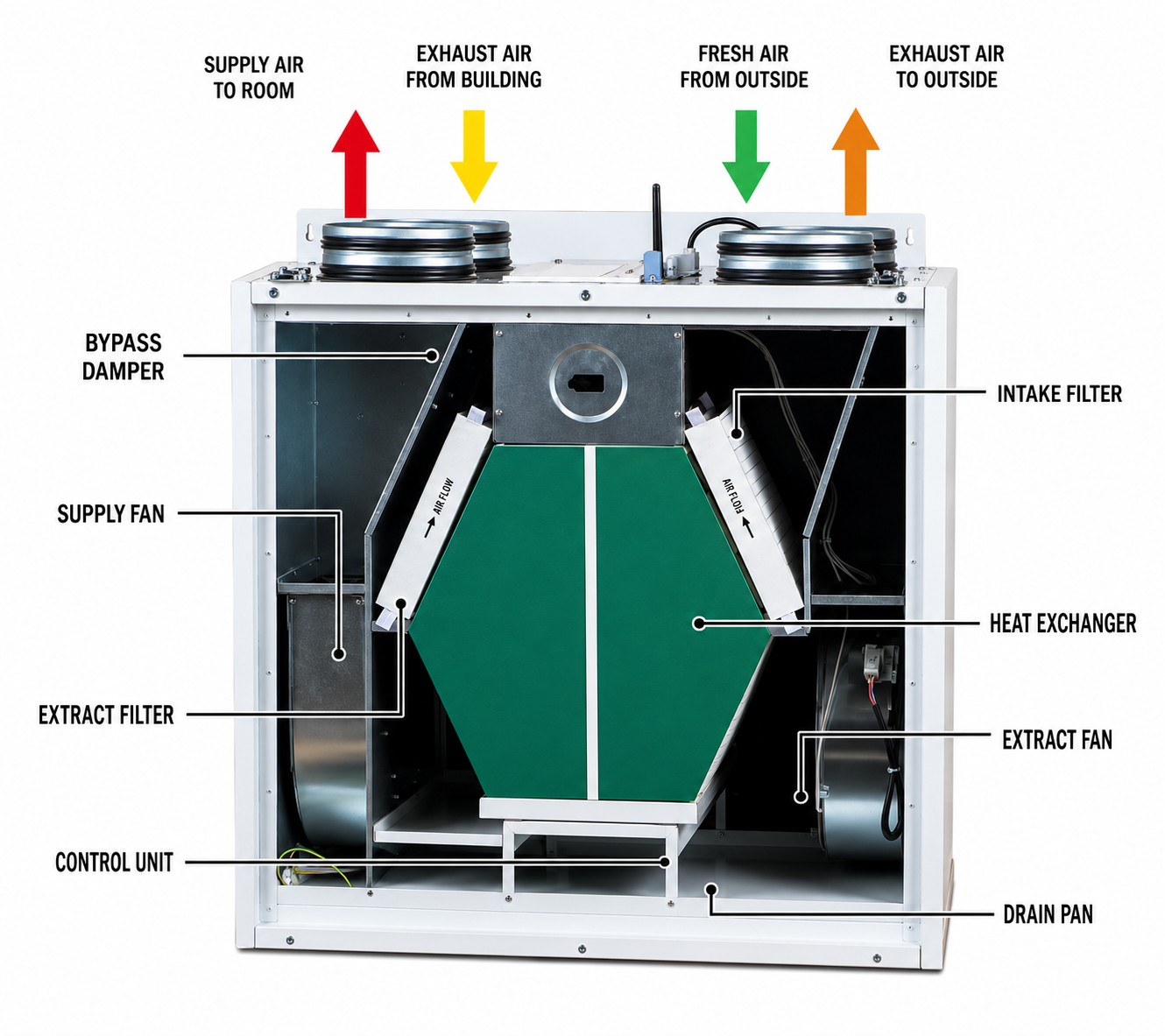
Supply air fan
Extract air fan
Supply air filter
Extract air filter
Heat exchanger
Control board
Temperature, pressure, humidity, CO₂ or VOC sensors
Main internal components of a residential heat recovery ventilation unit.
Supply Air Fan
The supply air fan delivers fresh outdoor air into living spaces. Its performance directly affects airflow stability, energy consumption and noise levels.
Fans are one of the core components of a ventilation unit. Ecodesign requirements helped move the market from older AC fans to more efficient and better controlled EC fans. EC fans usually have their own electronics and can react to overload or other operating issues.
High-quality fans from manufacturers such as ebm-papst, Ziehl-Abegg and S&P are found in many higher-quality ventilation units. In well-designed systems, expected service life can often reach around 15 years.
Extract Air Fan
The extract air fan removes stale air from bathrooms, kitchens, utility rooms and other extract zones. Together with the supply fan, it helps maintain balanced airflow throughout the building.
Supply Air Filter
The supply air filter cleans incoming outdoor air before it enters the home. Depending on the selected filter class, it can remove dust, pollen, fine particles and part of urban pollution.
Another very important role of the supply filter is to protect the unit itself from contamination and clogging. For this reason, operating a ventilation unit without filters should be avoided.
Extract Air Filter
Many homeowners assume that the extract filter is used mainly to clean indoor air. In reality, its primary purpose is to protect the ventilation unit itself from dust and contamination coming from extract air.
Practical note: one common maintenance mistake is mixing up the supply and extract filter positions. If the manufacturer has not clearly marked the filter locations, it is worth marking them yourself during maintenance.
Heat Exchanger
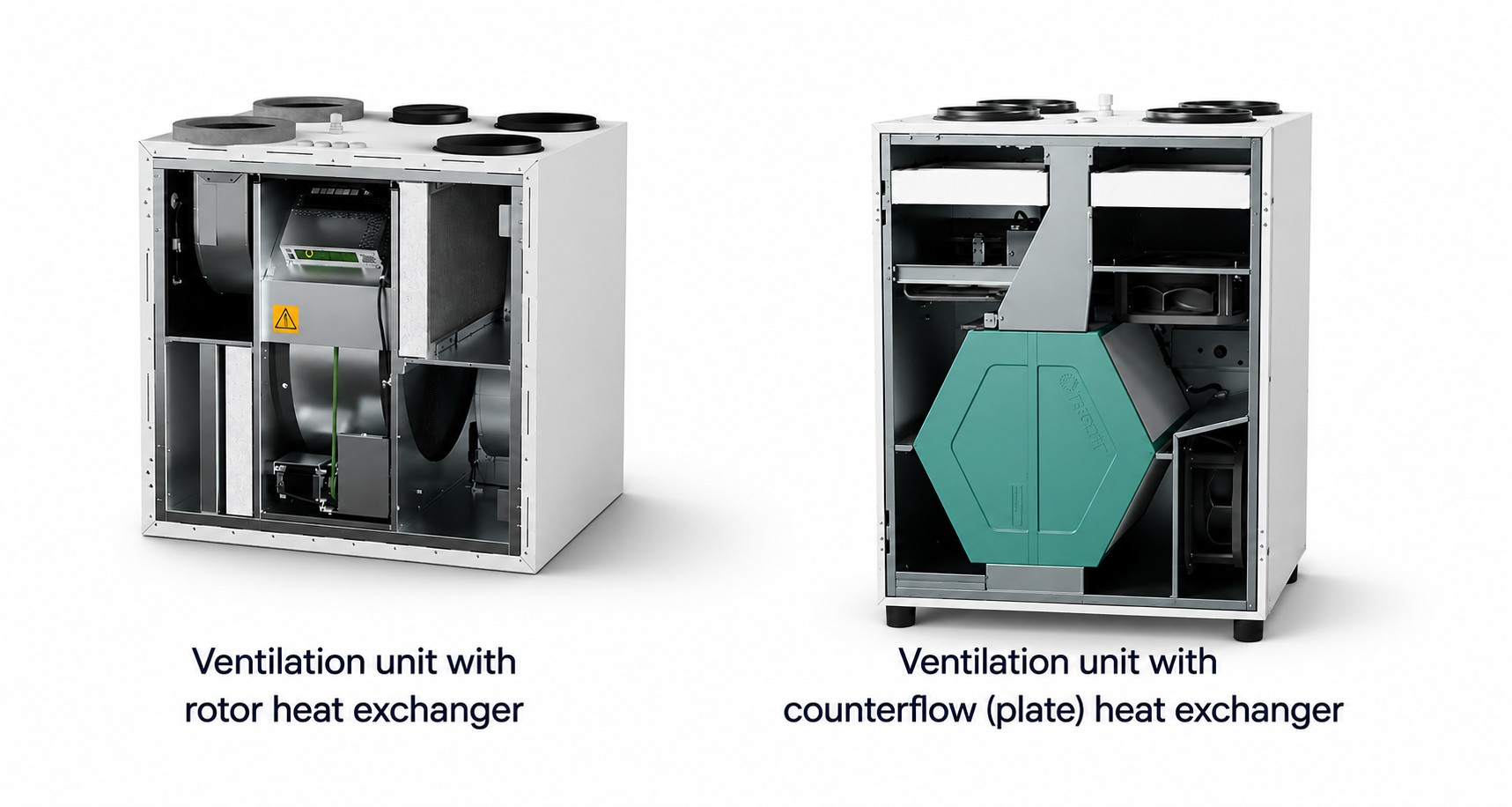
Rotary and counterflow heat recovery ventilation units.
The heat exchanger is responsible for recovering heat from extracted indoor air and transferring it to incoming fresh air.
Common heat recovery technologies include counterflow condensing heat exchangers, rotary condensing heat exchangers, counterflow enthalpy heat exchangers, rotary sorption heat exchangers and, more rarely, heat pumps.
Each technology has advantages and limitations. The best option depends on climate, building type, humidity level, maintenance expectations and budget.
Counterflow and Rotary Heat Exchangers
Rotary condensing heat exchangers have important advantages compared with standard counterflow units in colder climates. They are much less sensitive to freezing and can often operate at very low outdoor temperatures, depending on the unit construction and control strategy.
However, rotary heat exchangers also have downsides. They usually require more maintenance, including belts and rotor sealing elements. Airtightness is also lower compared with plate heat exchangers, which means that a small portion of extract air may be transferred back to the supply side. Rotary wheels can also add some sound due to rotation.
Counterflow heat exchangers usually provide high heat recovery efficiency, but their main disadvantage is frost risk. In cold weather they require frost protection, often using a preheater. This can consume significant energy on very cold days, because outdoor air may need to be warmed before entering the heat exchanger.
Condensing counterflow units also require a drainage system for condensate. If drainage is not properly connected or maintained, water leakage from the unit may occur.
Heat exchanger type
Main advantage
Main limitation
Counterflow condensing
High heat recovery, good airtightness
Frost risk, requires drainage
Rotary condensing
Better frost resistance in cold climates
More moving parts, lower airtightness
Counterflow enthalpy
Heat and partial humidity recovery
May require replacement depending on model
Rotary sorption
Good humidity recovery
More maintenance and moving parts
A common misconception is that counterflow heat exchangers do not require maintenance. In reality, condensing versions should be periodically cleaned, and some enthalpy versions may require replacement after several years, depending on the model and manufacturer.
Another common misconception is that anti-icing algorithms completely eliminate frosting problems. Some algorithms reduce airflow or change fan balance to protect the heat exchanger. This can help the unit continue operating, but it may also reduce indoor air quality, create negative pressure and increase noise levels.
Humidity Recovery
Ventilation units with humidity recovery, such as enthalpy plate heat exchangers or sorption rotary heat exchangers, can be a good solution in colder regions with low indoor humidity during winter.
However, humidity recovery is not always the best solution. In seaside regions, during transition seasons or in newly built homes with high moisture loads, moisture removal may be more important than moisture recovery.
Controls, Sensors and Optional Components
The control board manages the operation of the unit. It controls fans, sensors, heaters, bypass dampers, alarms and communication with external devices.
Preheater
Used mainly to protect plate heat exchangers from freezing during cold weather.
Post heater
Provides additional heating of supply air after heat recovery for improved comfort.
Constant airflow
Maintains stable airflow even when filters become dirty. This function is often undervalued.
Depending on the model, ventilation units may include temperature sensors, pressure sensors, humidity sensors, CO₂ sensors and VOC sensors. These sensors help optimize comfort, energy consumption and air quality. They are also one of the reasons why control quality has become so important in modern ventilation units.
What Does a Modern Ventilation Unit Actually Do?
A modern residential ventilation unit supplies fresh outdoor air, removes stale indoor air, filters pollutants and recovers heat from extract air.
Advanced systems may also recover part of indoor humidity, automatically adjust airflow, provide higher filtration performance and maintain airflow despite filter loading.
Why Do Ventilation Units Cost Different Amounts?
This is one of the most common questions homeowners ask. The answer is rarely a single specification.
In practice, the price difference often comes from engineering quality, component selection, software development and testing.
Better fans
Higher efficiency, lower noise and longer service life.
Better controls
More reliable operation and fewer service issues.
Better engineering
Lower noise, better airflow paths and easier maintenance.
Two units may have very similar specifications on paper but perform differently in real life. Noise, reliability, comfort and maintenance requirements depend heavily on internal layout, airflow paths, insulation and testing.
Are All Ventilation Brands Different?
The European market includes premium manufacturers, value-oriented brands and budget-focused solutions.
Premium manufacturers usually invest more in product development, software, testing and support networks. Examples include Zehnder, Brink, Wolf and Systemair.
Many Central and Eastern European manufacturers offer excellent value by adopting proven technologies and focusing on cost efficiency. Examples include Komfovent, Salda, Thessla Green and Blauberg. Italian brands such as Vortice, Aerauliqa and Brofer are also present in the residential ventilation market.
There are also budget-oriented manufacturers that focus mainly on reducing purchase cost. These units may be suitable for some projects, but buyers should pay more attention to component quality, control reliability, spare parts availability and after-sales support.
Fans: premium fans are usually more expensive, more reliable and better engineered.
Casing: acoustic insulation and overall rigidity make a real difference.
Component arrangement: internal layout affects noise, efficiency and service access.
Testing: frost protection algorithms and stable performance require costly testing.
After-sales support: spare parts availability and service speed matter over time.
Frequently Asked Questions
What is the difference between a ventilation unit and a heat recovery unit?
A heat recovery unit is a type of ventilation unit that recovers heat from extracted indoor air and transfers it to incoming fresh air. Not every ventilation unit includes heat recovery, but most modern residential ventilation units in Europe do.
How long does a ventilation unit last?
A well-maintained ventilation unit from a good manufacturer can last more than 15 years without major issues.
Do ventilation units improve indoor air quality?
Yes. A properly designed and maintained ventilation unit removes stale indoor air and supplies filtered fresh air from outside.
Can a ventilation unit remove pollen and fine dust?
Yes, but it depends on the filter class. Filters from around M5 / ePM10 level can remove pollen efficiently. For fine dust, an F7 / ePM1 class filter is usually required.
Why is my ventilation unit noisy?
Noise can come from fans, airflow, ducts, poor unit selection, poor placement, insufficient silencers, dirty filters or component defects. Rotary heat exchangers may also produce additional sound due to wheel rotation.
Do all ventilation units recover moisture?
No. Standard counterflow condensing heat exchangers do not recover moisture. Condensing rotary heat exchangers may return a small amount of moisture. For significant humidity recovery, an enthalpy plate heat exchanger or sorption rotary heat exchanger is required.
What maintenance does a ventilation unit require?
All ventilation units require filter replacement and periodic cleaning. Units with rotary heat exchangers may require belt or sealing replacement. Counterflow condensing units may require heat exchanger cleaning and drainage system maintenance. Some enthalpy heat exchangers may need replacement after several years.
How often should ventilation filters be replaced?
It depends on filter type, filter class and outdoor air pollution. In many homes, filters are replaced twice per year, before and after the heating season. However, highly polluted areas, city centres, busy roads, solid fuel heating areas and industrial zones may clog filters much faster.
Is a decentralized ventilation unit as good as a centralized system?
Decentralized ventilation is usually a cost-driven solution for older buildings where installing central ventilation is impossible or too expensive. The main disadvantages are more individual devices, limited effective ventilation area and usually more limited filtration options.
Conclusion
A modern ventilation unit is much more than a box with two fans. It is a complete air treatment device tha
t supplies fresh air, removes stale indoor air, filters pollutants and recovers heat.
The real difference between units is often found in engineering, component quality, control logic, testing and long-term service support. For homeowners, understanding the basic components and operating principles makes it much easier to compare ventilation units and avoid poor decisions based only on price or brochure specifications.
Manage Consent
To provide the best experiences, we use technologies like cookies to store and/or access device information. Consenting to these technologies will allow us to process data such as browsing behavior or unique IDs on this site. Not consenting or withdrawing consent, may adversely affect certain features and functions.
Functional
Always active
The technical storage or access is strictly necessary for the legitimate purpose of enabling the use of a specific service explicitly requested by the subscriber or user, or for the sole purpose of carrying out the transmission of a communication over an electronic communications network.
Preferences
The technical storage or access is necessary for the legitimate purpose of storing preferences that are not requested by the subscriber or user.
Statistics
The technical storage or access that is used exclusively for statistical purposes.The technical storage or access that is used exclusively for anonymous statistical purposes. Without a subpoena, voluntary compliance on the part of your Internet Service Provider, or additional records from a third party, information stored or retrieved for this purpose alone cannot usually be used to identify you.
Marketing
The technical storage or access is required to create user profiles to send advertising, or to track the user on a website or across several websites for similar marketing purposes.