As the heating season approaches, the air we breathe deserves attention too. In Northern Italy’s Po Valley, geography and weather can allow fine-particle pollution to build up. Here is what PM2.5 means for health—and what you can do, with or without a ventilation system.
Why Northern Italy’s air needs attention
The Po Valley is surrounded by the Alps and Apennines. During periods of light winds and temperature inversions, pollution from heating, traffic and other activities can remain close to the ground. Source: ESA
Emissions + stagnant air ↓ Less dispersal ↓ More particles in the air we breathe
Mist and smog over the Po Valley, 29 January 2024. This is a satellite photograph, not a PM2.5 concentration map. Credit: contains modified Copernicus Sentinel data (2024), processed by ESA. Original image · CC BY-SA 3.0 IGO. Displayed without image edits.
Invisible particles. Real health effects.
Lungs & airwaysRespiratory illness and worsening of existing conditions.
Heart & circulationHigher risk of cardiovascular disease.
Brain & blood vesselsExposure is linked to stroke risk.
Risk depends on exposure and individual vulnerability. These are health associations, not a diagnosis. Source: WHO.
PM2.5 means airborne particles no larger than 2.5 micrometres. They can penetrate deep into the lungs. Exposure is associated with respiratory and cardiovascular disease; repeated exposure matters beyond the obvious smog days. Source: WHO
Children, older adults and people with heart or respiratory conditions deserve particular attention during pollution episodes. WHO health guidance
Which cities have high PM2.5 levels?
Among the provincial capitals monitored in Legambiente’s Mal’Aria 2026 report, the highest 2025 annual averages included:
2025 annual mean · µg/m³
1Monza25
2Cremona22
3Rovigo21
4Milan20
5Pavia20
6Vicenza20
7Turin20
8Padua20
Selected city averages, not live readings or a pollution heatmap. Map boundaries: Natural Earth.
Milan, Pavia, Vicenza, Turin and Padua were reported at approximately 20 µg/m³. These are annual averages, not today’s readings or a ranking of every town. Source: Legambiente, 2025 ARPA data, Table 4
For comparison, the WHO annual guideline is 5 µg/m³—a health recommendation, separate from legal limits. WHO air quality guidelines
Three practical steps before the heating season
1. Check the air near you
Use your regional ARPA reports or the European Air Quality Index. Local conditions matter, including near busy roads and homes using solid fuels.
2. Adjust your daily routine
Choose less polluted routes and times for outdoor activity. At home, reduce particle sources such as smoking and unnecessary burning. Check local advice during pollution episodes. WHO practical advice
3. Give indoor air some attention
Maintain the ventilation your home needs. If you have an MVHR system (mechanical ventilation with heat recovery)—check its filters. Without an MVHR system, a suitably sized portable particle air cleaner can help reduce indoor particles, alongside controlling indoor sources. WHO: indoor air and filtration
Have an MVHR system? Check its incoming-air filter
ISO CoarseLarger dust & lintMainly coarse-particle filtration
ePM10PM10 fractionEfficiency assessed for particles up to 10 µm
ePM2.5PM2.5 fractionEfficiency assessed for particles up to 2.5 µm
ePM1PM1 fractionEfficiency assessed for particles up to 1 µm
Magnified illustrative particle shapes, not microscope photographs. PM fractions overlap; the examples are not exclusive to one size group. Whole pollen grains can be larger than PM10. Compare the declared efficiency and model compatibility.
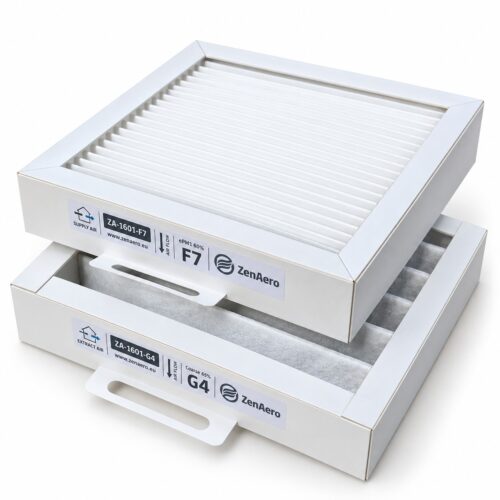
Where your unit supports it, a compatible F7 / ePM1 60% supply-air filter is an option for fine-particle filtration. F7 is the familiar older classification; ePM1 60% is the declared PM1 efficiency class. The two labels are not automatically equivalent. Eurovent filter selection guidance
The synthetic nanofibre material used in our F7 filters offers up to 80% PM2.5 filtration efficiency, according to supplier technical data. This is material performance, not a promise of 80% cleaner air throughout the home.
ZenAero’s selected filters are made in the EU. The supplier describes the F7 Nano material as fully synthetic and mechanically filtering, without an artificial electrostatic charge. Correct fit helps limit air bypass, while airflow resistance also matters for fan energy use. Eurovent: airflow resistance and energy
Illustrated three-stage depth filtration. Particle shapes are magnified and not to scale; capture occurs throughout the composite.
“I live in an area where solid fuels are used for heating and experience poor air quality firsthand. That is why I use an F7 / ePM1 60% filter in my own compatible MVHR during autumn and winter.” — A personal note from ZenAero
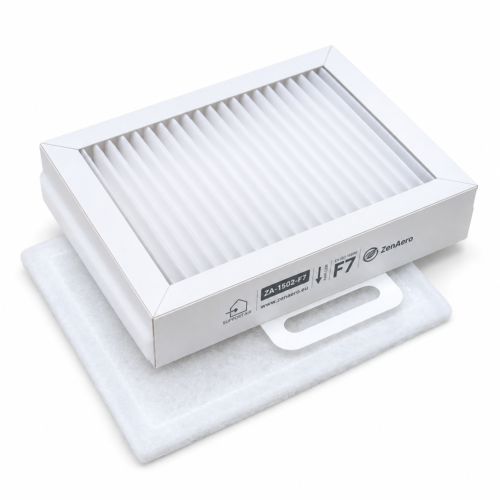
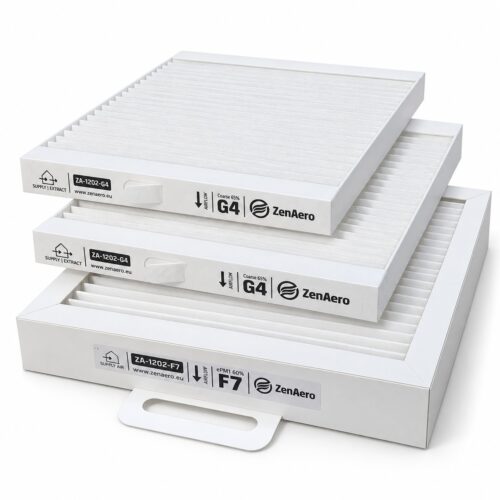
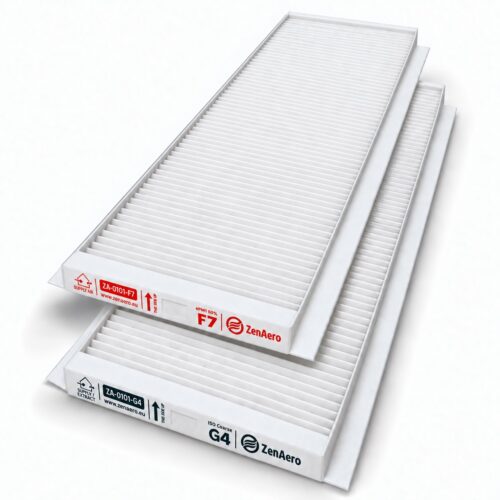
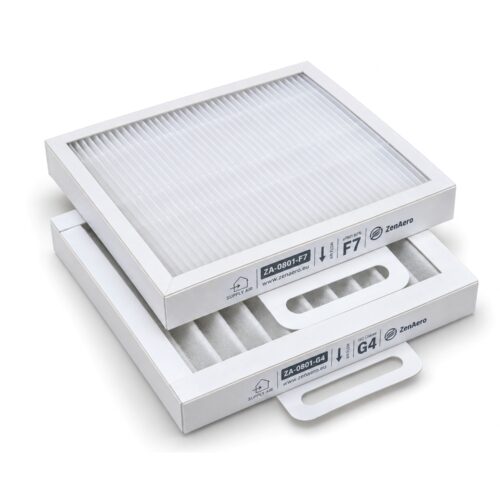
Selected F7 filters for compatible MVHR models
Already have one of these units? Check its exact version and filter dimensions before choosing.
PM2.5 is airborne particulate matter with an aerodynamic diameter of up to 2.5 micrometres. These fine particles can penetrate deep into the lungs and affect respiratory and cardiovascular health.
Why does pollution build up in the Po Valley during the heating season?
Heating adds emissions, while the surrounding mountains, light winds and temperature inversions can limit their dispersal. Pollution can accumulate near the ground.
How can I reduce exposure if I do not have an MVHR system?
Check local ARPA air-quality reports, adapt outdoor routes and activity times, and reduce indoor particle sources. A suitably sized portable particle air cleaner can also help reduce indoor particles; it does not replace ventilation.
Which MVHR filter should I choose for autumn and winter?
Where your unit supports it, consider a compatible supply-air F7 filter with a declared ePM1 rating, such as ePM1 60%. Check your model, dimensions and installation instructions. F7 and ePM1 are different classifications, not a universal one-to-one conversion.
Does up to 80% PM2.5 filtration mean 80% cleaner air throughout my home?
No. Up to 80% refers to the supplier’s declared F7 Nano material efficiency for PM2.5. Whole-home results depend on the installed filter, airflow, fit, building and indoor pollution sources.
Manage Consent
To provide the best experiences, we use technologies like cookies to store and/or access device information. Consenting to these technologies will allow us to process data such as browsing behavior or unique IDs on this site. Not consenting or withdrawing consent, may adversely affect certain features and functions.
Functional
Always active
The technical storage or access is strictly necessary for the legitimate purpose of enabling the use of a specific service explicitly requested by the subscriber or user, or for the sole purpose of carrying out the transmission of a communication over an electronic communications network.
Preferences
The technical storage or access is necessary for the legitimate purpose of storing preferences that are not requested by the subscriber or user.
Statistics
The technical storage or access that is used exclusively for statistical purposes.The technical storage or access that is used exclusively for anonymous statistical purposes. Without a subpoena, voluntary compliance on the part of your Internet Service Provider, or additional records from a third party, information stored or retrieved for this purpose alone cannot usually be used to identify you.
Marketing
The technical storage or access is required to create user profiles to send advertising, or to track the user on a website or across several websites for similar marketing purposes.