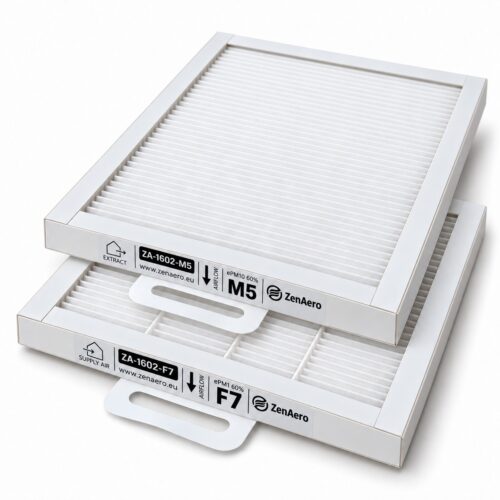
For an Aerauliqa QR unit, the best filter is the one that matches your exact model, dimensions, thickness, position and specified filtration class. There are three practical routes: an original Aerauliqa KF kit, a compatible replacement set verified for your model, or an individually assessed custom filter when the unit or housing has no catalogue match. This guide compares the options and explains how to read G4, M5, F7 and ISO 16890 before ordering.
Heat-recovery ventilation units are designed to operate across a range of airflows and pressures. Their actual operating point depends on the ducts, terminals and system settings. A correctly sized compatible filter with specifications suitable for the unit does not damage it simply because it is not an original part. Dimensions, sealing, filtration class and airflow resistance all matter. Maintenance makes the difference: a heavily loaded filter increases resistance and may reduce airflow or make the fans work harder to maintain it. Regular replacement helps keep the system working properly.
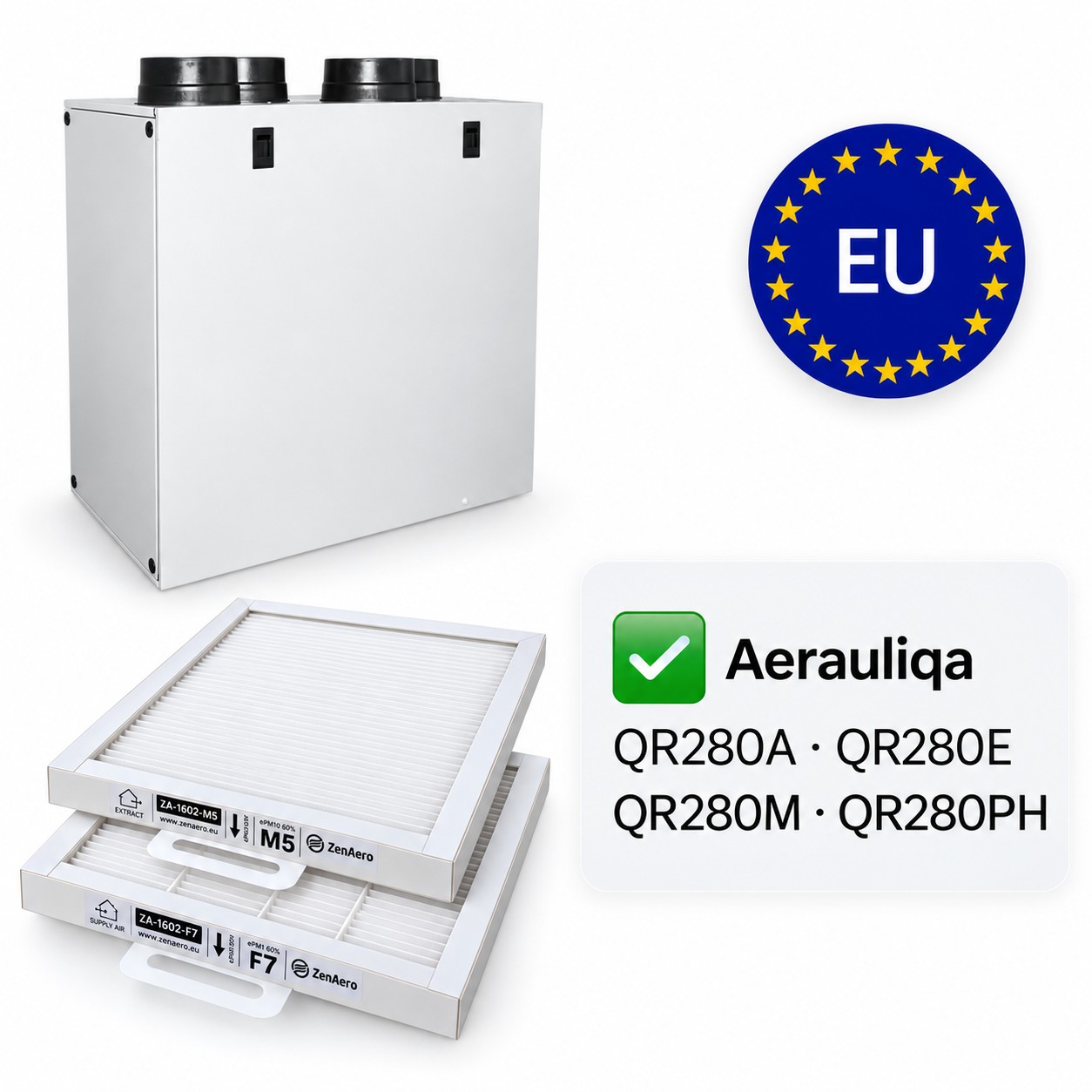
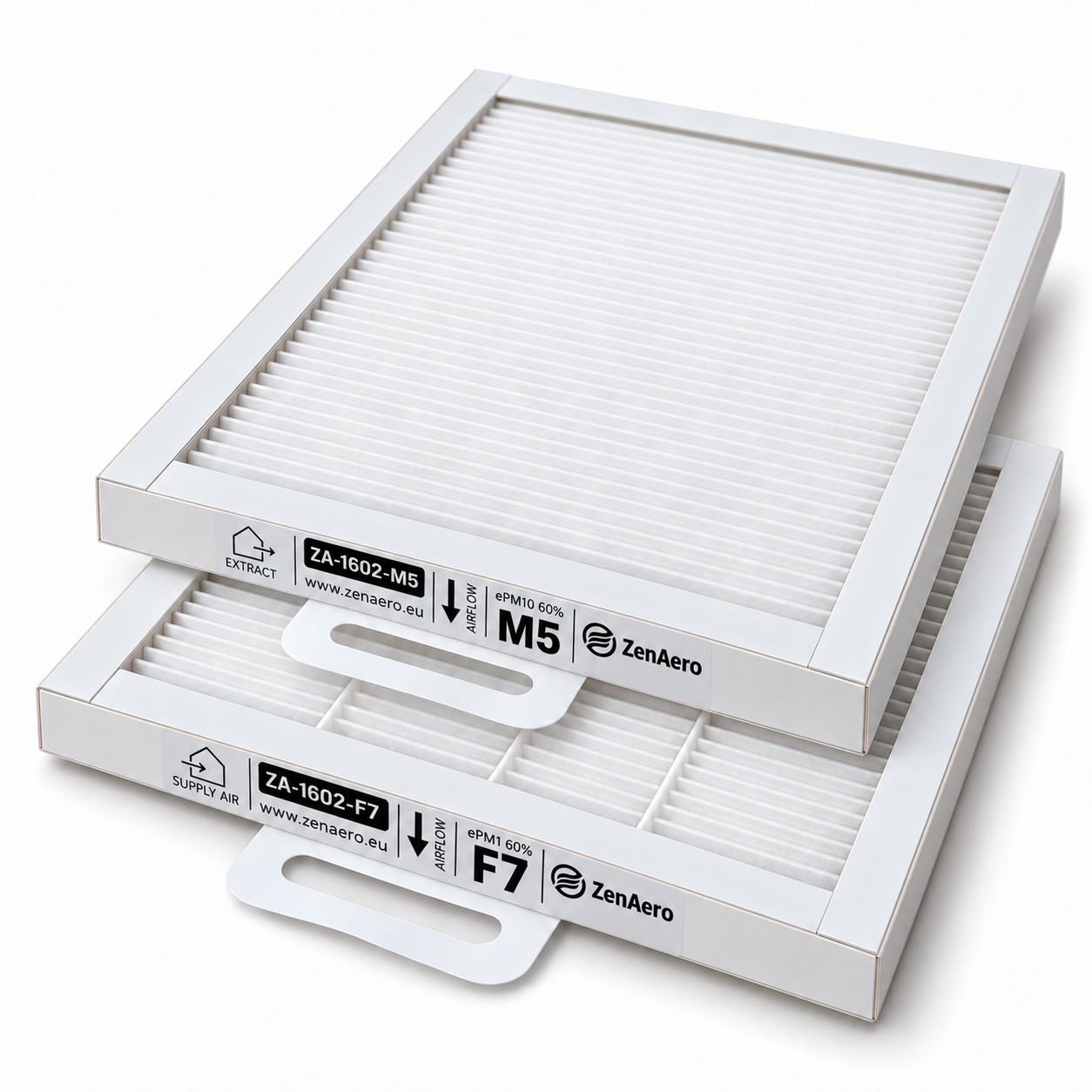
Example for Aerauliqa QR280A / QR280E / QR280M / QR280PH: compatible ZenAero F7 + M5 set, 250 × 183 × 21 mm. QR180/QR230E filters have different dimensions; check your model in the guide’s table.
In brief
Identify the model first: QR180/QR230E and QR280 need different sets. Read the complete designation on the unit’s identification plate.
Original or compatible: the KF kit is the manufacturer’s reference; a compatible set is an alternative when dimensions and filtration specifications match the unit.
Class is not everything: a coarse filter protects the heat exchanger, while a finer supply-air filter captures smaller outdoor particles. The combination matters.
No exact universal conversion: G4, M5 and F7 are not identical to ISO 16890 ratings. Check the declaration for each product.
Replacement intervals vary: follow the unit’s maintenance instructions and actual operating conditions.
The QR range includes different sizes and variants. The KF catalogue lists pairings by full model designation: do not choose using “QR” or a photograph alone. Our examples cover QR180A / QR180M / QR180PH / QR230E and QR280A / QR280E / QR280M / QR280PH.
The manufacturer’s KF data sheet lists separate filter versions for sizes 100, 120, 180, 280, 340 and 400, with their own codes and classes. There is no universal QR filter.
Before looking for a replacement, record:
The complete model code, including the suffix, such as QR280PH.
Width × height × thickness in millimetres, read from the label or measured after removing the filter.
The class of each filter, such as G4, M5, F7 or an ISO 16890 rating.
Its position: outdoor/supply air or extract air from the rooms.
These four details make the choice a comparison rather than a guess.
Original, compatible or custom-made?
Four types of offer are worth distinguishing. An original Aerauliqa KF kit carries the unit manufacturer’s replacement code: check the precise kit and availability through distributors or installers. A compatible ZenAero set lists specific QR variants, dimensions and declared filtration ratings; your complete model must appear in the compatibility list.
Other compatible replacements should be assessed using the technical sheet for the specific product, including thickness and pressure drop. Custom-made filters require exact measurements and the appropriate frame and class, particularly for modified or non-standard housings.
Original Aerauliqa KF kits
The KF range includes G4, M5 and F7 filtration elements. The catalogue lists G4 and F7 for size 180 and M5 and F7 for size 280, with model-specific pairings. Original kits are normally obtained through distributors or the installer.
The KF sheet identifies codes and classes; it is not a photographic comparison of ZenAero compatible sets. The replacement photographs below come from the relevant ZenAero product pages.
Compatible replacement filters
Compatible filters are independently made replacements, not original parts. Prefer a product sheet naming the exact compatible units, dimensions in millimetres and declared ISO 16890 class over a generic “suitable for Aerauliqa” description. If considering a higher class such as F9, check whether the unit permits it and compare pressure drop at the same airflow. Material, area and construction affect resistance as well as class.
Custom-made filters
If the unit is absent from catalogues, the housing has been modified or only the filter measurements are known, provide accurate dimensions and the required class. Have the suitability of the proposed custom replacement confirmed rather than improvising an approximate fit.
G4, M5 and F7: which combination?
G4, M5 and F7 come from the former EN 779 standard and remain common commercial descriptions. ISO 16890 classifies performance against particle fractions using ISO Coarse, ePM10, ePM2.5 and ePM1, with the relevant declared efficiency. The testing methods differ: an F7 is not automatically ePM1 60%.
For the ZenAero sets in this guide, the declarations are:
Filter
Commercial class
Declared ISO 16890 rating
Typical purpose
Coarse
G4
ISO Coarse
Capture dust and coarse particles
Medium
M5
ePM10 60%
Capture a proportion of smaller particles
Fine
F7
ePM1 60%
Increase capture of fine particles
Why two different classes?
In a balanced heat-recovery unit, filtration has two roles. As discussed in the REHVA Journal article on filtration in MVHR homes, coarser filtration can protect the heat exchanger, while a finer supply-air filter reduces outdoor particles entering the dwelling.
Extract air: usually a coarse or medium filter to protect the exchanger.
Outdoor/supply air: usually a finer filter such as F7 / ePM1.
Pressure drop: compare at the same airflow; media, pleat area, construction and loading matter.
Use the pair specified for the model or a permitted alternative. Fitting two F7 filters where F7 + G4 is intended, or swapping their positions, is not an automatic improvement.
Dimensions and compatible sets by model
Compatible unit models
Combination
Declared ISO 16890 classification
Dimensions of each filter
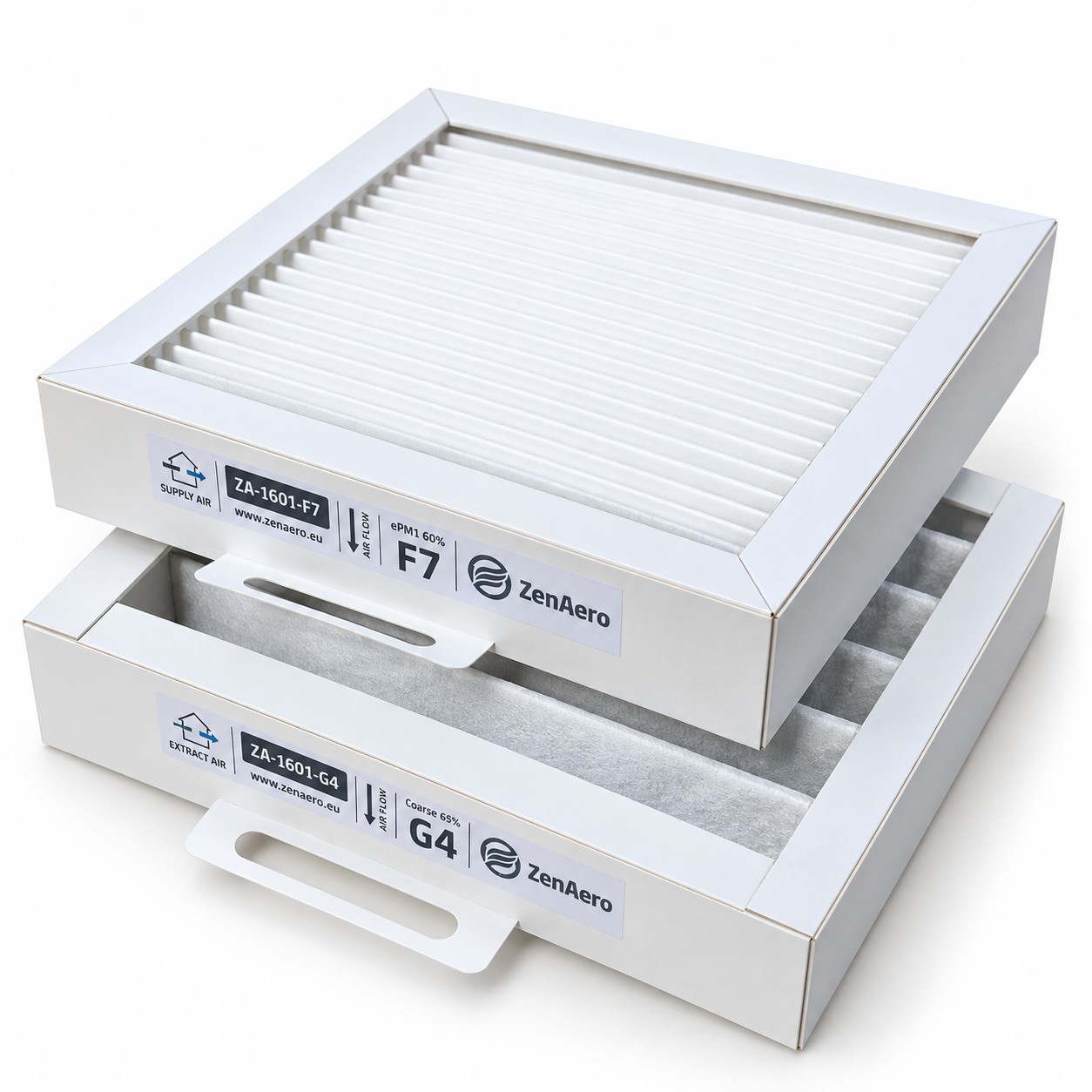
QR180A, QR180M, QR180PH, QR230E
F7 + G4
ePM1 60% + ISO Coarse
200 × 200 × 46 mm
QR280A, QR280E, QR280M, QR280PH
F7 + M5
ePM1 60% + ePM10 60%
250 × 183 × 21 mm
The manufacturer’s KF catalogue supplies class and model pairings; the dimensions and ISO percentages in this table come from ZenAero product specifications. The thicknesses are 46 mm and 21 mm: these sets are not interchangeable. Check the complete unit variant and the position of each filter.
QR180A / QR180M / QR180PH / QR230E — F7 + G4, 200 × 200 × 46 mm. View the compatible filter setQR280A / QR280E / QR280M / QR280PH — F7 + M5, 250 × 183 × 21 mm. View the compatible filter set
The QR280 set contains F7 + M5, declared as ePM1 60% + ePM10 60%. One pack is one set of two filters; verify the selected pack and quantity before ordering. For other QR sizes, use the catalogue or ask us to check the unit rather than choosing an approximate match.
Five checks before ordering and fitting
Switch the unit off as instructed in the manual before opening the filter compartment.
Read the identification plate and record the full model code.
Remove and inspect the filters: record dimensions, thickness, class and airflow direction, usually marked by an arrow.
Compare the product information: the model list and all three measurements must match.
Check supply and extract classes: refit in the correct positions and follow the airflow arrows.
If a detail does not match, or previous replacements have no identifiable specification, return to the unit manual. Read the compatibility guide.
When should you replace your QR filters?
There is no interval suitable for every QR unit. Frequency depends on model, class, running hours, airflow and outdoor conditions. Traffic or nearby building work can load filters faster than a cleaner location. Use the unit manual and any maintenance indication as the starting point.
During inspection, look for heavily darkened or clogged media, a distorted frame, damaged seals, reduced airflow at terminals, damp filters or signs of mould. Clean or wash only when the instructions explicitly permit it for that filter type; otherwise replace the loaded filter.
If the unit is installed in an unheated garage or technical room, also check humidity and condensation. Cold surfaces can collect condensation, as discussed in this external article on garage condensation and sectional doors. A damp environment also affects filter housings.
Our aim is to offer European-quality compatible filters, effective filtration and good value. At ZenAero, the value of a replacement lies in its materials, careful assembly and suitability for the ventilation system.
European quality: filters made in the EU, selected materials and careful assembly, with frames designed to fit their intended housing precisely.
Value compared with original replacements: an alternative designed to reduce maintenance costs without paying for the ventilation-unit manufacturer’s branding. Compare prices for the same model, class and number of filters per pack.
F7 / ePM1 60% for supply air: products carrying this rating help capture fine smog particles, soot, pollen and other particles that can carry allergens.
Filtration and airflow: our F7 filters are designed to balance fine-particle efficiency with air permeability, supporting regular ventilation operation.
Maintenance that protects your system: a suitable replacement changed at the right time avoids prolonged operation with a clogged filter. Service life depends on outdoor air, airflow and operating conditions.
The ePM1 60% declaration describes efficiency against PM1 particles under ISO 16890; it does not mean that every particle or allergen is removed. Choose the set specified for your model and maintain it according to the unit’s instructions.
Compatible Aerauliqa QR filter sets
These sets fit different models and have different dimensions. Choose only the set listing your complete unit designation. Price and availability depend on the selected pack.
Select options
This product has multiple variants. The options may be chosen on the product page
Our catalogue includes compatible QR180/QR230E and QR280 sets with model lists, dimensions and ISO 16890 ratings. If your model is absent or the housing is non-standard, ask us to verify the replacement or request Custom-made ventilation filters with the unit designation and measurements.
Frequently asked questions
What is the difference between F7 and G4?
G4 mainly captures coarser dust and protects the heat exchanger. F7 captures a larger proportion of small particles. For the ZenAero QR180 set, the G4 element is declared ISO Coarse and the F7 element ePM1 60%; always read the individual product sheet.
How many filters does an Aerauliqa QR have?
Balanced units such as QR180 and QR280 use two filters, one in the outdoor-air stream and one in the extract-air stream. Replacement sets commonly combine two classes. Check the exact number and positions in your model’s manual.
Can a compatible filter be a good alternative to the original?
Yes, when dimensions, thickness and class meet the unit’s requirements and the ISO 16890 declaration is clear. It is still an independently manufactured replacement, not an original part. The full model designation remains essential.
How often should QR filters be changed?
Follow the unit’s manual, maintenance indication and actual filter condition. Outdoor air, operating hours and class all affect the interval; there is no universal schedule for every installation.
All trademarks belong to their respective owners and are used only to identify equipment and replacement compatibility. ZenAero compatible filters are not original parts from the ventilation-unit manufacturer. Before ordering, check the full model, dimensions and product specifications.
Manage Consent
To provide the best experiences, we use technologies like cookies to store and/or access device information. Consenting to these technologies will allow us to process data such as browsing behavior or unique IDs on this site. Not consenting or withdrawing consent, may adversely affect certain features and functions.
Functional
Always active
The technical storage or access is strictly necessary for the legitimate purpose of enabling the use of a specific service explicitly requested by the subscriber or user, or for the sole purpose of carrying out the transmission of a communication over an electronic communications network.
Preferences
The technical storage or access is necessary for the legitimate purpose of storing preferences that are not requested by the subscriber or user.
Statistics
The technical storage or access that is used exclusively for statistical purposes.The technical storage or access that is used exclusively for anonymous statistical purposes. Without a subpoena, voluntary compliance on the part of your Internet Service Provider, or additional records from a third party, information stored or retrieved for this purpose alone cannot usually be used to identify you.
Marketing
The technical storage or access is required to create user profiles to send advertising, or to track the user on a website or across several websites for similar marketing purposes.